Zapier for Etsy Listings: 5 Alternatives Compared
Zapier for Etsy Listings: 5 Alternatives Compared
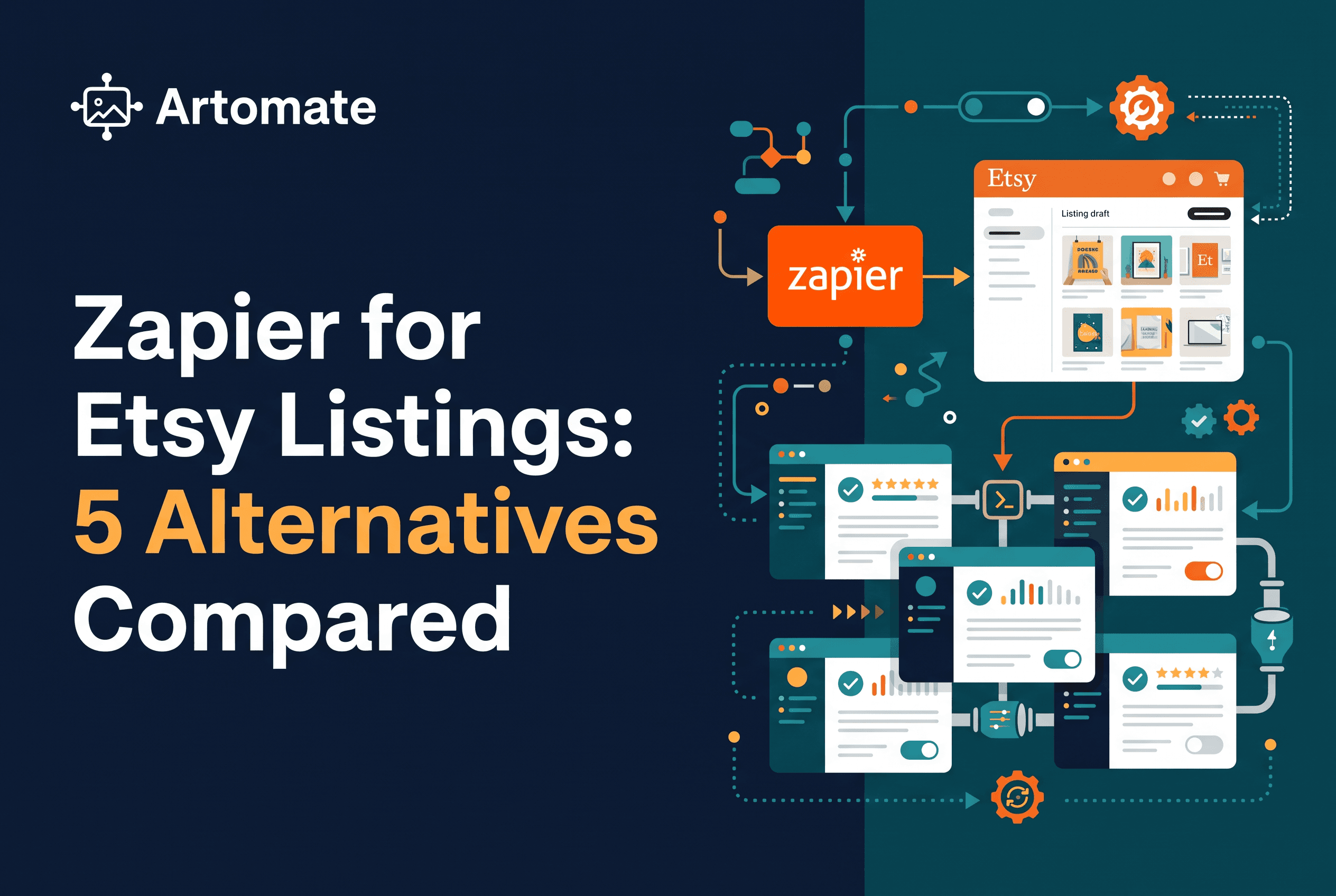
Zapier cannot create Etsy listings natively. Its own Etsy app page reads "Not Yet Supported" (Zapier). If you searched "zapier etsy listings" hoping for a plug-and-play flow, you need a different route, and which one depends on what you have already made.
Etsy's Open API does let approved apps create draft listings, so the capability exists. Zapier just has not built a connector for it. Below are the five routes that actually work, what each one automates, and where each one stops. Most of them move data around, and only one also produces the artwork, mockups and copy that go into the listing.
Can Zapier create Etsy listings? What its Etsy page and Etsy's API actually say
No. Zapier's Etsy integrations page shows "Not Yet Supported" (Zapier). Some third-party write-ups describe Etsy triggers and actions in Zapier, but Zapier's own page is the one to trust, and it lists none. Check the app directory inside your own account before building anything around it.
That doesn't make Etsy listing automation impossible. Etsy publishes an Open API v3 with a createDraftListing operation (Etsy Open API reference). Any tool that connects to that API can create drafts. Zapier just isn't one of them for Etsy.
So the real question is which tool sits on top of the Etsy API in a way that fits how you work.
How Etsy draft listings work through the Open API (create draft, images, publish as separate steps)
Through the Open API, a listing is built in separate steps: create an inactive draft, attach images, then publish. The createDraftListing call is a POST to your shop's listings endpoint and needs an OAuth token with the listings_w scope. The body requires a quantity, title, description, price, who_made, when_made and a taxonomy_id.
A draft stays a draft until it has at least one image and you flip it active with updateListing and state: "active". Physical listings also need a shipping profile and a processing profile.
Two things follow from this. Every tool below does the same three API steps, and the only difference is how much work you do before and around them. And the draft stage is a gift, because it's a natural place for a human review before anything goes live. Etsy also has no native CSV upload, which is why bulk drafts go through a tool connected to the API. For the bulk angle specifically, see Bulk Upload Etsy Listings: 5 Tools Compared.
What is the safest way to automate listings with review before publishing?
Automate everything up to a draft and keep publishing manual. The Etsy Open API separates creating a draft, uploading images and publishing, so a tool can build the listing without making it live. You then open the draft in Etsy, check the title, tags, price and images, and publish yourself. Artomate follows this pattern. It prepares Etsy draft listings for your review rather than publishing on its own, so a bad title or wrong mockup never goes live on your shop.
1. Make.com: the closest no-code replacement for a Zapier Etsy flow
Make.com is the closest no-code swap for what you wanted from Zapier, because it has a real Etsy app. You connect your Etsy account, then build scenarios from modules. Its Etsy modules include watching shop receipts and transactions, plus a Create a Listing module that creates a draft rather than a published listing (Make Etsy app). Make also warns that Etsy's API rate limits are shared at the application level, so heavy runs can queue.
Best for: sellers who already have the title, description, tags and images ready and want a visual scenario that pushes them into Etsy as drafts, or that reacts to orders.
Limitation: Make moves data, it doesn't make it. Artwork, mockups and listing copy have to exist before the scenario starts, and you maintain the scenario yourself. For a hands-on comparison, read Make.com vs axiom.ai vs Artomate for Etsy Listings.
2. MESA: Etsy-focused automation templates
MESA is built around Etsy and ships ready-made templates, so you skip most of the blank-canvas setup. Its Etsy template list includes sharing new Etsy listings on Pinterest, syncing Shopify products to your Etsy shop, updating listing prices from a spreadsheet, and generating product descriptions (MESA).
Best for: sellers who want templated workflows around an existing catalogue (price updates, cross-posting and description generation) without wiring modules by hand.
Limitation: the templates are aimed at managing listings you already have. None of the listed templates produces poster artwork or mockups, so the creative production step stays manual.
3. axiom.ai: browser automation when there is no API module
axiom.ai automates your browser instead of calling an API, which makes it the fallback when no ready-made Etsy module does what you need. Its pitch is that if you can do something in a browser and explain it in a sentence, it can run it (axiom.ai). New accounts get 2 free hours of runtime, and usage is measured in runtime rather than listings (axiom.ai pricing).
Best for: one-off jobs where you want a bot to click through Etsy's Shop Manager, for example filling fields from a sheet.
Limitation: it mimics a person in a browser, so it's slower and more fragile than an API call, and it breaks when the page layout changes. It still needs every field and image prepared in advance.
4. Google Sheets flows: spreadsheet to draft listings
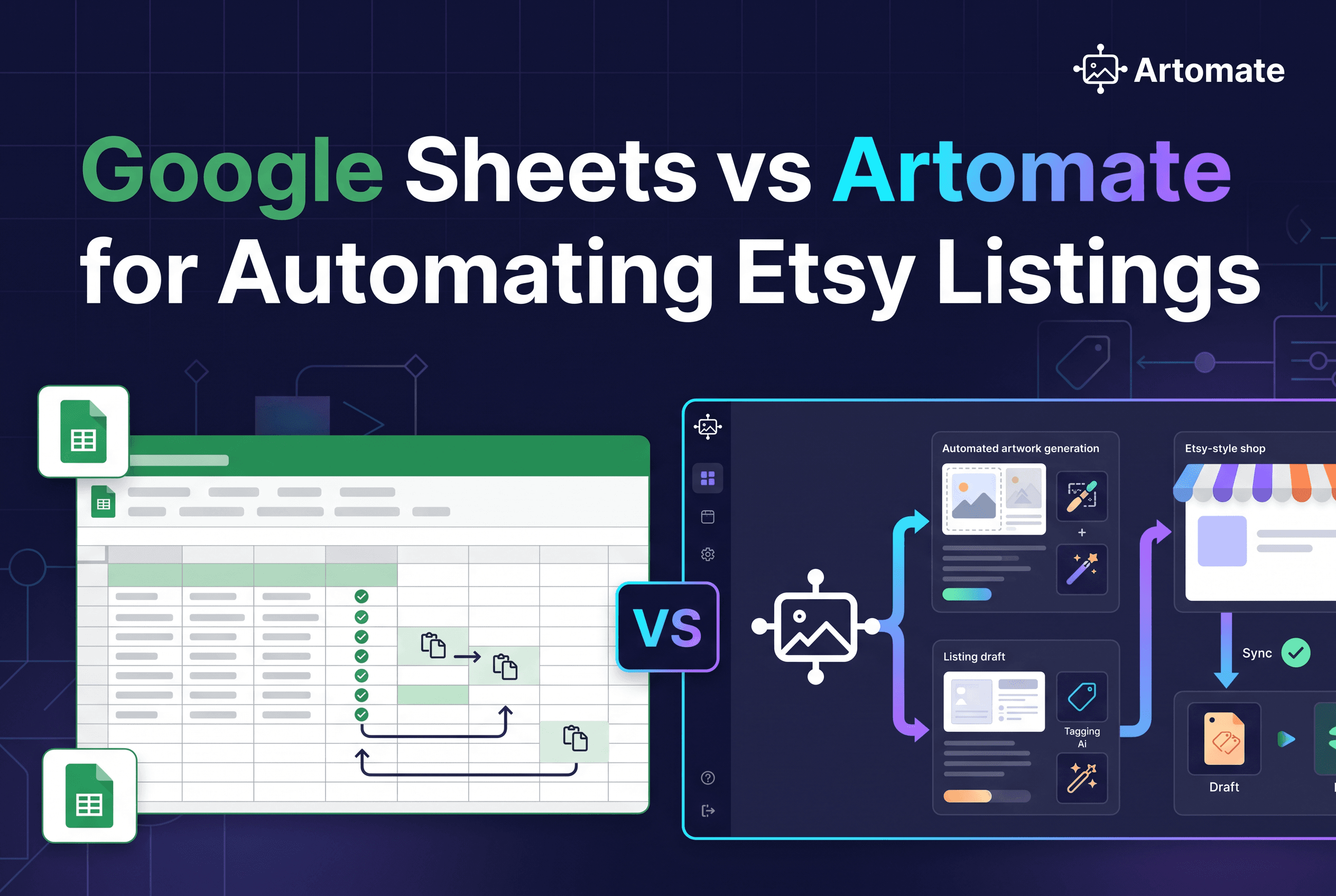
A Google Sheets flow turns a spreadsheet row into a draft listing. Sheets is the control panel, and Make.com, MESA or a script is the engine. One row holds the title, description, tags, price and image links. The flow reads it and calls the Etsy API.
This is the most flexible and the cheapest way to start, and it's how a lot of sellers get their first batch of drafts live. MESA even has a template for updating Etsy prices from a spreadsheet (MESA).
Best for: sellers comfortable maintaining a sheet who already have finished assets.
Limitation: the sheet is only as good as what you type into it. You still write every title and tag set, build every mockup, and host the image files. If you want AI-written copy in the cells, you add yet another step to the chain.
5. Artomate: poster artwork, mockups, copy and Etsy drafts in one workflow
Artomate is a workflow tool for Etsy print-on-demand poster sellers. It goes from demand research to a finished draft listing, so you review the result instead of assembling it. It researches adjacent poster ideas using your paid Etsy order history or platform demand signals, generates the artwork with current AI image models, creates cloud PSD mockups without Photoshop, and prepares Etsy draft listings with artwork, mockups, titles, descriptions and tags. It connects through the Etsy API and leaves the publish decision to you.
That's the difference from the four options above. Zapier-style tools and spreadsheets start after the creative work is done. Artomate treats the artwork, mockups and copy as part of the same run, and it can run on a schedule in the background.
Best for: poster sellers who want to grow a catalogue without rebuilding mockups and listing copy for every design.
Limitation: it's built for Etsy and for posters only. It isn't a general automation platform, and Artomate is not endorsed or certified by Etsy, Inc. It doesn't print or ship either, so it sits alongside your print provider, not in place of one.
Plans on the pricing page include a pay-per-generation Flex option, so you can test one draft before committing. Check the live page for current prices.
Can AI write Etsy titles, descriptions and tags from your images?
Yes. Most AI listing tools take an image of the product and draft a title, description and tags from what they see. Quality depends on the image and on how well you check the output against Etsy's limits, such as 13 tags and a 140-character title. Artomate prepares listing copy as part of its poster workflow and then prepares an Etsy draft for your review. Read the copy before publishing, because AI can miss your niche keywords or tone.
How to choose: what you have already made versus what still has to be produced
Choose by what exists today. If the assets are finished, you need a mover. If they aren't, you need a producer.
| Route | Etsy draft creation | Makes artwork | Makes mockups | Writes copy |
|---|---|---|---|---|
| Zapier | Not supported natively | No | No | No |
| Make.com | Yes, Create a Listing module (draft) | No | No | No |
| MESA | Template-based Etsy workflows | No | No | Description template |
| axiom.ai | Via browser automation | No | No | No |
| Google Sheets flow | Via Make, MESA or script | No | No | Only what you type |
| Artomate | Yes, drafts via the Etsy API | Yes | Yes | Yes |
If you have artwork, mockups and copy ready and just hate uploading, pick Make.com or a Sheets flow. If you mostly need to maintain an existing catalogue, MESA's templates fit. If you need a bot to click where no API module exists, axiom.ai covers it.
If you sell posters and the bottleneck is producing each design's artwork, mockups and copy, the others leave that part on your desk. Artomate takes it off.
What can you actually automate on Etsy in 2026?
You can automate the repetitive steps around a listing, but the choice of what to sell and the final publish stay with you. Etsy's Open API lets approved tools create draft listings, attach images and update listing fields. Platforms like Make.com and MESA then connect those steps to spreadsheets or files. If you already have finished artwork and copy, a connector flow can load them. If you still need artwork, mockups and copy, a workflow like Artomate's covers those steps and leaves you a draft listing to review.
How do you automate Etsy product listings with AI end to end?
Start by splitting the job into artwork, mockups, listing copy and the Etsy draft, then decide which steps AI handles. Generic connectors like Zapier or Make.com move data between apps but don't create the poster, the mockup or the copy for you. For print-on-demand poster sellers, Artomate generates poster artwork, turns designs into mockups, prepares listing copy and prepares Etsy draft listings for your review. That cuts out the repetitive path from a finished design to an Etsy-ready listing, so you spend your time choosing designs and checking drafts.
Start with one poster draft, not a whole pipeline
Zapier won't create your Etsy listings, and the tools that will mostly shift data you already prepared. If your real time sink is making the artwork, mockups and copy, run one poster through Artomate, review the Etsy draft it prepares, and judge the workflow on that single listing before you scale anything.

George Jefferson
Founder of Artomate
George has generated over £100k selling AI-generated posters on Etsy and built Artomate to automate the entire print-on-demand workflow. He writes about AI art, Etsy strategy, and scaling a POD business.
Learn more about me →