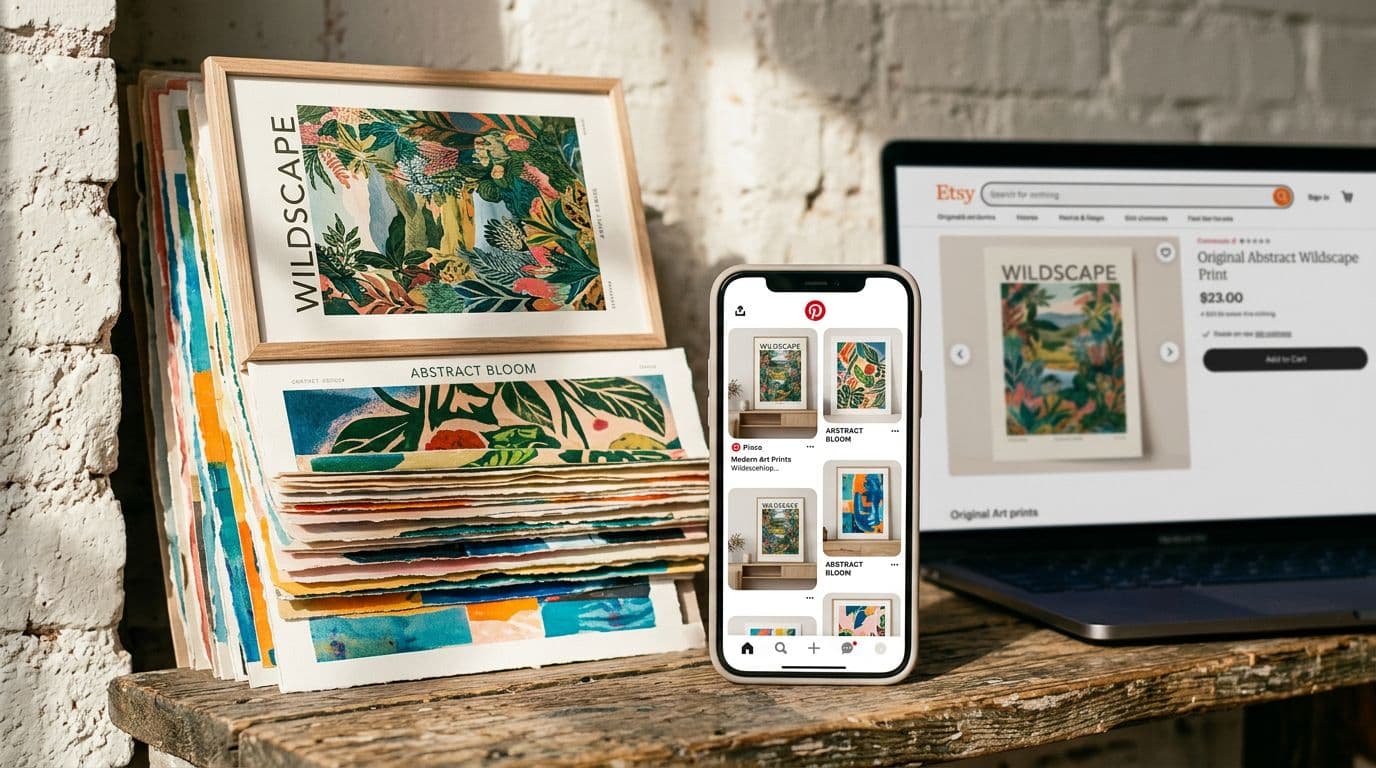
How to Use Social Media to Drive Traffic to Your Etsy Poster Shop

Selling posters on Etsy used to be mostly about having a few great listings and waiting for search to do the rest. That stopped being reliable a few years ago. What I learned the hard way is that if you want steady growth you have to treat social platforms like active storefronts, not just places to post pretty pictures. Social traffic is visual, direct, and it converts well for posters because people see a room transformation and imagine that print on their wall. The trick is turning views into clicks and clicks into orders without blowing margins on ads. In this article I’ll walk through what I actually do in my shop: the channels I prioritize, the content that works, how I test ads cheaply, which tools make scaling realistic, and the operational moves that keep orders profitable. If you want to drive traffic Etsy from social platforms and grow predictably, this is the roadmap I use.
Why social media matters for Etsy poster sellers
I started taking social seriously after one week where a single TikTok sent me more traffic than a full month of Etsy search. That was the turning point. Posters are made for social — they show up in rooms, they transform a space in a three-second clip, and viewers make instant purchase decisions. Because of that, social platforms are now one of the fastest ways to drive traffic to Etsy, and they do it at a lower cost than many paid Etsy options when you get the creative right.
Social also buys you three things Etsy search does not: new audiences, repeat exposure, and user content. A viral clip brings fresh buyers who would never have found your listings through Etsy keywords. Reposting and repinning keeps those images working for months. And customer photos become fresh creative, which I reuse in ads and listings. All that matters because Etsy’s algorithm rewards listings that convert, but it can only convert if people land on the listing in the first place.
When I plan content, I think of social like a funnel. TikTok and Reels are discovery engines. Pinterest is the evergreen bridge that keeps a product in front of people searching for wall art. Email and retargeting are where I pull people back and recover abandoned interest. You should have a plan for each of those steps, and that plan should be measurable. I set simple KPIs: daily visits from social, conversion rate for traffic coming from social, average order value, and CAC. Without those numbers you’re guessing.
Why posters work better than many products
Posters map perfectly to short video and pins because they’re visual and affordable. A room transform clip that shows before and after hooks viewers quickly. Closeups sell texture and color. And because printing and shipping for posters can be inexpensive with the right partner, you can make ads and boosts profitable without exotic margins.
What Etsy actually rewards
Etsy still uses keywords, but it rewards listings that bring in buyers. That means a listing that gets clicks and converts will climb. Social traffic is a way to jumpstart that behavioural signal. In practice, I spend a few weeks testing social creatives so the winners can send targeted traffic to the best listings. Then I let Etsy’s search do the rest.
A quick warning about margin
Social can scale quickly, which is both good and dangerous. You need to know your true unit economics. Factor in the $0.20 listing fee, 6.5% transaction fee, payment processing, your POD cost, and shipping. If your margins are thin, even high-converting social traffic will lose you money. I’ll show you how I keep ads cheap and AOV healthy later in the post.
Current market trends and what they mean
The checklists I used in 2022 look different now. The market has kept growing, but the rules changed. Advertising formats consolidated around short vertical video. AI design tools are faster and better, which means more competition but also faster iteration. Etsy’s fee structure stayed stable, which helps planning, but the platform shifted to favour shops with scale. That means the winners often aren’t simply the most talented artists; they’re the sellers who can produce consistent creatives, list broadly, and maintain fast fulfillment.
Pricing is the other big shift. I see printable downloads cluster in the low price bands and physical posters sitting in the £19–£50 range. I sell a lot at two price points because it covers both impulse buyers and those willing to pay more for larger or limited prints. That split helps me manage acquisition cost. If a conversion costs me £6 and the average order is £34.99 with a £12 profit, that’s fine. If most orders are £9.99 printables, the same acquisition cost kills the business.
TikTok remains the fastest way to get a large amount of high-intent traffic. Instagram Reels will amplify any clip that already proved itself on TikTok, and Pinterest continues to deliver steady, searchable traffic weeks and months after you post. For me, that mix is predictable: TikTok for spikes and tests, Instagram for repeated exposure, Pinterest for longevity.
There’s also a practical point on fulfillment. POD options can change the math overnight. That’s why I use Printshrimp for posters. Their pricing and included shipping mean I can price A1 around £34.99 and still pocket healthy profit. That consistency lets me be confident when testing paid traffic.
What the fee numbers mean for you
Etsy’s $0.20 listing fee and roughly 10% effective take after transaction and processing means you must price with at least a 30–40% margin if you intend to advertise. I run the numbers before I boost anything.
Why AI tools are both helpful and risky
Image and video models let you prototype designs in hours, not weeks. I use models from the recommended list to speed iterations and make mockups cheaper. But AI introduces IP risk and buyer trust issues. I keep records of prompts and edits for every AI-assisted design and add a brief disclosure in listings when appropriate. That protects me and helps build trust.
The scale game on Etsy
Etsy rewards shops with more listings because more listings mean more indexed keywords. Successful shops often have hundreds of listings. That’s why automation matters if you want to compete at scale.
Get your shop ready: listings, pricing, and fulfillment
Driving traffic is only half the battle. If your listings don’t convert, you’ll pay for vanity metrics and lose money. My first rule is this: don’t push paid or social traffic to a listing that isn’t conversion-ready. Conversion-ready means strong images, clear shipping times, polished descriptions, and pricing that leaves margin for ads. I’ve thrown traffic at listings that looked great on mobile and watched it bounce because the shipping times were three weeks or the photos were inconsistent.
Start with your top three listings. Update titles to put the primary keyword first. Fill every attribute and use all 13 tags. Add a short listing video that shows the poster in a framed setting on a room wall and shows a quick zoom into the texture or paper. I find a 5–8 second clip with an obvious before/after hook performs best on social and helps conversion when people arrive from a video.
Pricing is where most sellers wing it. I price prints so I have at least £10–£20 gross margin on average physical sizes after POD and fees. For example, an A1 that costs me ~£11.49 with Printshrimp comfortably sells at £34.99 and leaves enough to buy a few pounds of advertising and still profit. I use tiers: a low-cost print for impulse buyers and a mid-premium for people who want a statement piece. That gives me room to run cheap ads and still be profitable.
Fulfillment details matter more than most sellers admit. Fast dispatch helps Etsy quality signals. I aim for same-day or next-day dispatch where possible. That reduces refund risk and increases buyer satisfaction. If you rely on a POD that takes a week to ship, your conversion will suffer as people see long processing times.
Title and tag hygiene
Put the main keyword at the start of your title. Use long-tail tags and variant phrases across the 13 tags. Rotate tags when seasonality or trends change. I check my Shop Stats weekly and make small tweaks rather than big rewrites.
Listing media checklist
Every listing should have: a hero lifestyle photo, two closeups, a simple product-only shot, a mockup showing scale, and a 5–8 second listing video. If you’re using mockup templates, keep them consistent so your brand looks professional.
Balance margin and experiments
If you don’t have margin for ads, don’t run them. Instead focus on organic social and email capture until you can test. I budget ad tests only from profitable SKUs, not from loss-leaders.
Content that converts on TikTok and Reels
Short video runs the discovery economy now. I make content with a simple rule: hook in the first two seconds, show transformation, end with a clear action. The three formats that consistently work for me are room transforms, process clips, and UGC-style reveals. Each serves a slightly different intent. Transforms show how the print changes a room, process clips build creator authority, and UGC-style clips create relatable social proof.
When I test new creatives, I publish the same video to TikTok, Instagram Reels, and YouTube Shorts to see which platform amplifies it best. Usually TikTok drives the spike, Reels adds repeat exposure, and Shorts sometimes brings slower, low-cost views. I pay attention to watch time, retention, and click-through for each platform. A video with a 30–40% 15-second retention is one to scale.
The copy on social matters even when the video is doing the heavy lifting. I use short captions that repeat the listing keyword and land a strong CTA like “see size options” or “shop the exact print on our Etsy” with a UTM link in bio. For Instagram I add a product tag when possible. For TikTok I pin the product link in the bio and use a landing page if I want an email capture first.
One practical trick that saved me hours: batch record room transforms. I set aside an afternoon to shoot five transforms in different rooms with consistent lighting and background. Then I edit three versions of each clip—short hook, mid-length process, and UGC remix. That gives me content for weeks.
Hooks that work
Start with a quick visual contrast: bare wall, then snapped reveal with the poster. Use on-screen text that repeats the product name and price point. If you want people to click to Etsy, show the price in the clip so they know it’s affordable.
CTA and links
Don’t rely on platform link features alone. Use a clear CTA to your bio link and include UTMs. I treat social posts as click drivers and measure which creative leads to visits and which leads to purchases.
Repurposing winners
When a clip performs, I make three variants: different opening, alternate music, and cropped for Reels. That keeps momentum without reinventing the wheel.
Pinterest as evergreen discovery for posters
Pinterest behaves like a search engine for visual products. Once you pin a high-quality lifestyle image with the right keywords, it can send traffic for months. I treat Pinterest as the slow but reliable leg of my marketing strategy. While TikTok delivers spikes and test data, Pinterest turns winners into long-term traffic.
My Pinterest posts are less about trends and more about search intent. I write keyword-rich descriptions and use clear category pins like “modern wall art” or “boho living room poster.” I pin both lifestyle photos and closeups. The lifestyle pins act as the top-of-funnel attraction while the closeups serve people who are comparison shopping.
A common mistake is treating Pinterest like Instagram and relying on engagement. That leads to inconsistent results. Instead, I test three image styles for each product: a clean room shot, a styled vignette, and a detailed texture closeup. One of those usually outperforms and becomes my evergreen pin. I then schedule repins and refresh the description seasonally.
Pinterest also plays well with SEO on Etsy. When your pin links to an Etsy listing, the traffic coming from a search-engine-like experience often has higher intent. I use UTMs to track this and compare Pinterest’s conversion to TikTok and Instagram. For me, Pinterest usually converts at a lower volume but at a steadier rate over time.
Pin format and keywords
Create tall pins (2:3 or 9:16 ratio) and lead with descriptive text in the image. Use the product keyword in the first 50 characters of the description. For example, “modern botanical poster for living room” matches search behaviour better than a vague caption.
Scheduling and repinning
Consistency wins. I use a scheduling tool and repin best performers once every 4–6 weeks. That keeps the content active without manual effort.
Pinterest + email
Pair pins with a free printable or discount landing page to capture email. That gives you direct access to buyers later and reduces CAC on repeat purchases.
Cheap paid tests and the metrics I watch
I used to blow budgets running broad campaigns. I learned to test small and fast. My rule of thumb is $5–$15 per day per creative for 7–10 days. That’s enough to understand if a clip has momentum without committing big ad spend. If a creative shows consistent click-through and a decent ROAS after that period, I scale. If not, I kill it and move on.
Measurement is simple. I track visits from each source, conversion rate, average order value, and CAC. The real number I care about is profit per visitor. If a channel sends 1,000 visitors and my conversion is 2% at an average order of £34.99 with a profit of £12 per order, that math tells me whether the spend made sense. Vanity metrics like likes and followers don’t pay the bills.
Set up pixels and UTMs before you start. TikTok Pixel and Meta Pixel are non-negotiable if you run paid tests on those platforms. UTMs let you break down which creative drove the traffic. I use simple UTM tags like utm_medium=tiktok&utm_campaign=room-transform&utm_source=social. With that I can tell if traffic from a certain video converted better than traffic from a different video.
Retargeting is a cheap way to recover interest. After a 7–10 day test, I retarget video viewers or website visitors with a special offer like free small-print upgrade or 10% off. That often reduces CAC because retargeting audiences have already shown interest.
Ad budget framework
Start with £5–£15 per day per creative. Run for 7–10 days. Scale winners by doubling daily spend and creating 2–3 variants to avoid ad fatigue.
Key metrics to stop or scale
Scale a creative if CTR is above your baseline and CAC is below target. Kill it if CTR is low and views aren’t converting to site visits. I also watch watch time on video-based ads; high watch time predicts click-through.
Landing pages vs direct to Etsy
I generally split tests. Some creatives go straight to the Etsy listing for a fast purchase. Others go to a lightweight landing page that captures email with a free printable. The landing page approach helps me build remarketing audiences and reduces CAC on repeat buys. For new shops with unproven listings, capture email first.
Tools and platforms I actually use
I’m picky about tools because each one adds cost and complexity. For image generation I use the models that give predictable, high-quality results. My go-to models are GPT Image 1.5 for tight composition control, Nano Banana Pro and Nano Banana 2 for studio-level output and excellent text rendering, Nano Banana for quick iterations, and Seedream 5.0 Lite for fast, high-fidelity outputs with strong multi-reference handling. Those models cut iteration time significantly and improve mockup realism.
For print fulfillment I rely on Printshrimp for posters. Their A1 pricing around £11.49 delivered, the museum-grade 200gsm paper options, and same/next-day dispatch in major regions make my unit math work. When I price an A1 at £34.99 I can advertise and still have solid profit margins. Printshrimp beat the usual suspects in my tests for poster pricing and shipping transparency.
For automation and bulk listing operations I use a couple of tools, including what I built at Artomate. This is exactly why we created Artomate — the mockup-to-listing pipeline is the real bottleneck when you want 500+ SKUs. Automating mockup creation, metadata generation, and bulk upload saves me hours and reduces errors. If you’re serious about scaling, automation tools pay for themselves.
For analytics and keyword research I use eRank and RankHero for Etsy SEO insights, and platform pixels alongside Google Analytics for cross-channel tracking. For scheduling I use a simple social scheduler and keep a spreadsheet with UTMs and creative variants. Keep a folder for your best-performing prompts and mockup templates so you can reproduce winners fast.
My tech stack at a glance
- Image models: GPT Image 1.5, Nano Banana Pro, Nano Banana 2, Seedream 5.0 Lite
- POD: Printshrimp for posters
- Automation: Artomate for mockups and bulk listing workflows
- SEO: eRank, RankHero
- Tracking: TikTok Pixel, Meta Pixel, UTMs
Legal and licenses
Before selling anything made with AI, I verify model commercial terms and keep prompt records. I also add a short AI disclosure in listings when I used AI assets. It builds trust and gives me a record if questions arise.
Scaling: automation, mockups, and bulk listings
If you want to play the numbers game on Etsy, you need systems. At first I made every mockup by hand and uploaded listings one by one. That got me traction, but growth stalled because I burned out. The change came when I automated the mockup pipeline and standardized metadata. That let me scale from dozens of listings to hundreds while keeping consistent quality.
Automation does two things well. First, it removes repetitive mistakes. Second, it lets you test more variants quickly. I use templates for mockups so that every product family has the same look and scale shots. Then I batch-generate lifestyle variations and export the best ones for ads. For metadata I use templates with fill-in-the-blank fields: primary keyword, size options, paper descriptions, and shipping copy. That keeps SEO consistent across hundreds of listings.
Bulk listing tools change the game. Instead of spending 20 minutes per listing, I can push 50+ listings in an hour when everything is templated. That’s how shops scale to 500+ listings — they don’t design each one from scratch, they produce variations fast and let the market decide winners. I still hand-tune the listings that start to get traction, but automation finds the winners faster.
Inventory and fulfillment scale differently. Even with POD you must watch dispatch times and returns. I monitor supplier performance weekly and keep a backup POD for peak months. If your main supplier slows, your Etsy ratings will suffer quickly.
Bulk mockup workflow
Create a master mockup template for each size. Batch-generate images with different room settings. Pick top-performing mockups for listings and ads. That process saves the most time and keeps brand consistency.
How I choose what to scale
I scale products that meet three conditions: they have steady conversion, the creative performs on social, and the POD cost leaves room for ads. If a design converts organically but dies under paid traffic, I pause and rework the ad creative, not the listing immediately.
Why automation is non-negotiable
When I automated, revenue doubled because I could list more niche variations and test more keywords. Etsy rewards quantity, but only if quality and fulfillment remain tight. Automation keeps both in check.
Common mistakes I still see and how to avoid them
I’ve seen more failed experiments than I care to admit. Most failures come from three places: poor listing basics, bad economics, and platform tunnel vision. Sellers obsess over followers or viral hits but skip the boring work that actually turns views into orders.
A top mistake is sending social traffic to an unready listing. I test listings before I put them in front of paid audiences. If the listing conversion is poor from organic traffic, I fix the listing first. Another common issue is underpricing. If you don’t factor in Etsy’s fees and POD costs, you’ll lose money as soon as you test ads. For example, a £9.99 printable that costs you £2 and brings a £5 CAC is not sustainable.
Solely relying on one platform is also dangerous. Algorithms change. Diversifying across TikTok, Instagram, Pinterest, and email gives you balance. I allocate time each week to create content for at least two platforms. That ensures one algorithm shift doesn’t wipe out traffic.
Legal mistakes around AI are becoming more frequent. Don’t assume AI outputs are safe to sell. I keep prompt records, save intermediate edits, and include a brief disclosure when I’ve used AI-generated assets. It avoids friction with buyers and gives me a paper trail if questions come up.
Mistake: ignoring metrics that matter
Followers feel good but don’t pay the bills. Track visits→orders, AOV, and CAC. Those numbers tell you whether a creative is worth scaling.
Mistake: no email capture
Without email, you’re at the mercy of platforms. Offer a free printable or a welcome discount to capture email. It’s the cheapest way to lower CAC on repeat buyers.
Mistake: doing everything by hand
Manual mockups, one-off uploads, and ad setups kill momentum. Invest in templates and automation. It’s the only way to scale without sacrificing quality.
Final Thoughts
Using social media to drive traffic to your Etsy poster shop isn’t a mystery. It’s a practical series of choices: make listings that convert, test creatives cheaply, capture email, and automate the repetitive work so you can keep testing. TikTok will get you quick signals, Instagram Reels will amplify proven clips, and Pinterest will keep traffic steady over time. Know your numbers before you boost anything and pick a POD partner that preserves margin. If you want to scale beyond a few dozen listings, plan for automation now. I built processes and tools around these exact problems because the time you save on mockups and uploads is time you can spend creating better designs and better content.
If you want help, I can put together a 30-day content calendar for TikTok, Reels, and Pinterest that matches your niche, or run a competitor listing audit to set price bands and keywords. Small tests first, scale the winners, and keep the basics tight. That’s how you turn social into predictable Etsy growth.

George Jefferson
Founder of Artomate
George has generated over £100k selling AI-generated posters on Etsy and built Artomate to automate the entire print-on-demand workflow. He writes about AI art, Etsy strategy, and scaling a POD business.
Learn more about me →