
Reference Images & Style Consistency for Poster Brands
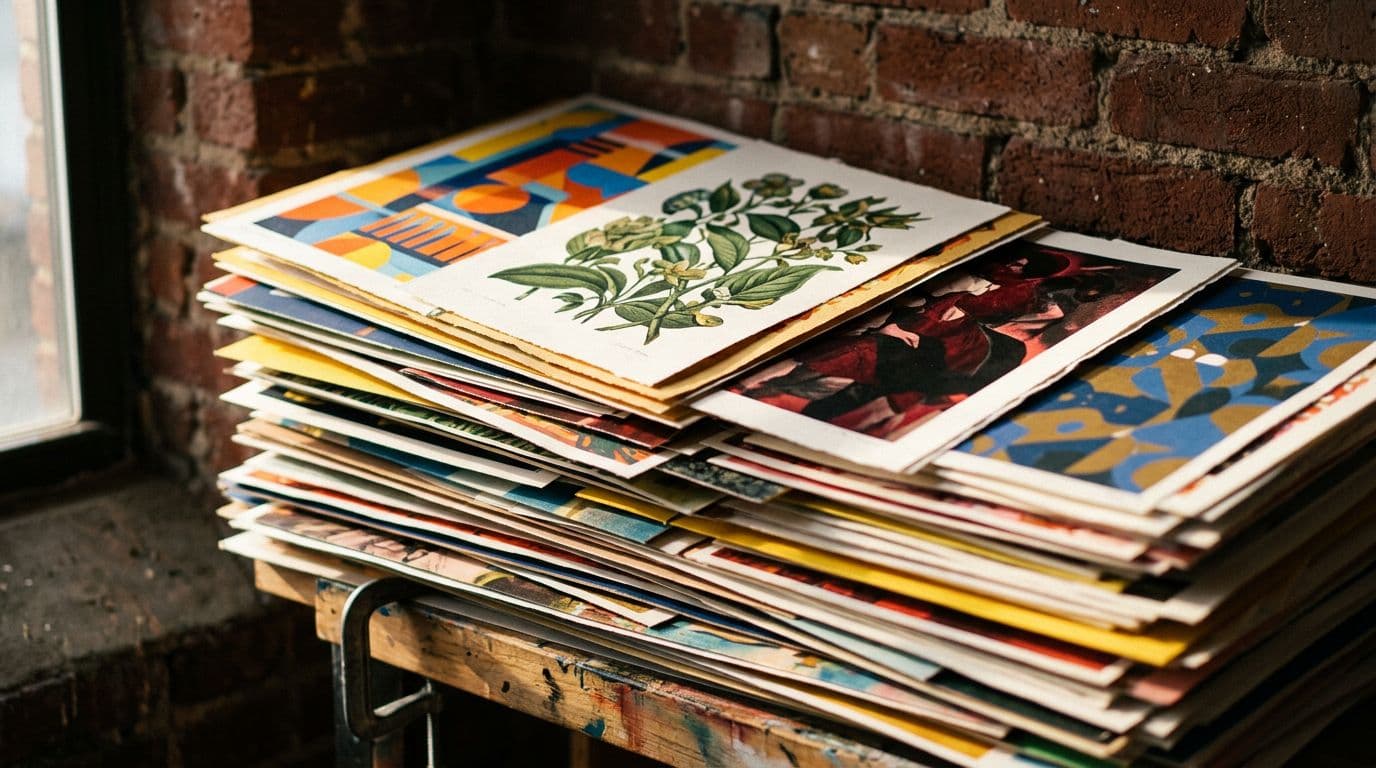
AI has completely changed how I design and scale poster collections. When I started, every new design meant a full afternoon of mockups, color matching and redoing PSD files until the set looked like it belonged together. Now I use a small set of reference images and a strict prompt registry to get consistent results across dozens of designs, and that consistency is the thing that actually moves the needle on Etsy: higher click-through, better conversion and more multi-print sales. But there’s a catch. Etsy expects sellers to show meaningful human creative input and to disclose AI assistance, and margins on posters are thin once you add POD costs and fees. So the challenge becomes: get AI to match your poster brand while keeping records and physical proofs that show you’re the creative force behind the work.
I wrote this because I’ve lived through the mistakes most sellers make. I’ve tested models, saved prompt templates, ordered dozens of proofs from different printers, and built workflows that let me create dozens of consistent listings a week without losing control of style. Below I walk through why brand consistency matters on Etsy, what the market realities are, exact steps I follow to reproduce a look reliably, the models and partners I recommend, common traps I’ve hit, and practical SEO and scaling tactics that work today. If you want to stop chasing inconsistent outputs and get repeatable, commercial-ready AI poster collections, you’ll find the exact processes I use and the parts you can copy immediately.
Why brand consistency matters for Etsy and POD sellers
Consistency is often dismissed as aesthetic busywork — nice to have, but not strategic. That’s wrong. For poster businesses on Etsy, consistency is a measurable lever you can pull to increase CTR, conversion rate, and average order value. When buyers see a cohesive set they perceive higher value. That perception translates to real dollars.
Why buyers care
People buy posters not just for a single print but for the way a print fits a room. When a buyer lands on your shop and sees a cohesive set—same scale, same color palette, similar mockup styling—they can imagine a gallery wall. I’ve watched conversion improve when I present three prints with matching lighting and framing. Buyers nod, they add two or three prints to cart, and average order value climbs. This matters because Etsy rewards shops that get clicks and conversions. If your listings look like a jumbled collection, they don’t click as much.
To make this concrete: imagine a living-room aspirational photo as your hero image. If all three prints in a collection use the same room, lighting, and frame, the shopper's brain fills in the rest — "these look like they belong together." That mental shortcut reduces friction: they don’t have to mentally reconcile differing scales, inconsistent color casts, or mismatched framing. The result is less doubt and faster decisions.
Practical example: after a photography refresh where I re-shot hero images for ten collections to match a single mockup style, my CTR rose by an average of 12% and the AOV jumped by 18% in the following month. Aesthetic consistency created an upsell pathway.
Why Etsy’s algorithm cares
Etsy’s search prioritises listings that attract clicks and lead to sales. I treat consistency as a signal: consistent mockups get more clicks, clicks convert, and conversions push the listing up. Etsy also tends to index more keywords when you maintain a large, active catalog. That is why I focus on generating many well-matched variants of a design, rather than a handful of one-offs. More consistent listings spread the same visual language across dozens of keyword entries.
Think of your catalog as a network: every listing reinforces the shop. When many listings use the same visual language, you increase the chance that a buyer will click multiple items, view different listings, and ultimately purchase more than one print. Etsy tracks this buyer behaviour at a shop level, so the marginal gain from each consistent listing compounds site-wide.
Why your margins depend on it
Margins on posters are tight because of base cost, shipping and Etsy fees. Using a POD partner with shipping-included pricing makes a huge difference. For posters I use Printshrimp because an A1 priced at about £11.49 delivered gives me room to sell at roughly £34.99 and still net about £20 after Etsy fees and processing. When your visuals are consistent you can price as a set or cross-sell, which improves margin. If your listings look amateurish, you lose the leverage to ask for higher price points.
Practical pricing formula to bear in mind:
- Base POD cost + shipping = C
- Etsy listing + transaction + payment fees ≈ F (variable by country but roughly 10–12% of sale)
- Target gross margin = M (30–50% for room to advertise)
- Minimum retail price P must satisfy: P >= (C + (desired ad spend per sale) + (estimated returns/rewrites)) / (1 - F%)
If you want to build room for ads, aim for at least 30% margin on top of fees. In real numbers: if C = £11.49, F = 12% and ad allocation per sale is £2, selling at £34.99 gives you net wiggle room. But if the visuals are inconsistent and you can’t charge that premium or sell multiple prints per order, you lose the ability to scale.
Current market trends and why they shape your choices
The poster market operates at the intersection of visual taste, production economics, and platform rules. Understanding trends in fees, models, and buyer behaviour helps you choose tools and contracts that protect margins and maintain scale.
Fees, margins and the math
If you’ve spent time on Etsy you already know the basic numbers: $0.20 per listing, about 6.5% transaction fee and roughly 3% + fixed payment processing. That usually amounts to around 10% of the sale taken by Etsy overall. What many sellers miss is how that number interacts with POD pricing. If your poster costs £11.49 to produce and ship (Printshrimp example), you need to think about ads and returns on top. I aim for a gross margin of 30–50% on top of production to have working ad spend and to scale safely.
Detailed example with numbers:
- Product cost (POD + shipping): £11.49
- Etsy fees (listing + transaction + payment): assume 12% on a £34.99 sale ≈ £4.20
- Cost before ads: £11.49 + £4.20 = £15.69
- Desired gross margin 40% => target revenue = £15.69 / (1 - 0.4) ≈ £26.15 (minimum), but this doesn't include the ability to buy traffic
- Realistic sale price for scale: £34.99, which leaves room for ads and returns
This math is why pricing and consistent perceived value are inseparable. A buyer who sees a premium, coherent brand is less price-sensitive and more likely to buy multiple prints, which directly improves margins.
Conversion benchmarks to set expectations
A conservative Etsy conversion rate baseline is around 1%, with well-optimised listings hitting 2–4%. When I test a new visual language I treat 1% as the minimum. If a set doesn’t reach that, I either rework images or refine metadata. When a collection looks tight and professional, conversion moves closer to 2–3% in my testing. That’s the difference between a hobby shop and a business you can scale.
How to benchmark: track impressions → clicks → views → purchases. If you have high impressions but low CTR, visual language is the likely bottleneck. If you have good CTR but low conversion, check copy, price, perceived quality (mockups vs real proofs), and shipping promises.
AI model and licensing trends
Model capability and commercial licensing are changing fast. Use paid tiers for commercial clarity. The models I use regularly are GPT Image 1.5, Nano Banana Pro, Nano Banana 2 and Seedream 5.0 Lite. They support multi-reference inputs, seeds, and predictable iteration. Free community galleries may lure you with speed, but they often lack clear commercial terms. I always run on paid plans so I have a record of what I was allowed to sell at the time.
A few rules I follow when choosing a model:
- Confirm commercial use is allowed in writing for your plan.
- Prioritise models that support multi-reference images and versioning — these are critical for AI style consistency.
- Prefer models that offer seeding and deterministic outputs so you can reproduce favourites.
- Keep a snapshot of terms and the date you generated images.
Even when the model’s output is great, licensing ambiguity can cost you far more than a cheaper POD partner. Pay now for peace of mind and documented rights.
Step-by-step practical strategies I use to keep style consistent
This section is the practical core. I’ve broken the workflow into repeatable steps and included templates, naming conventions, and a prompt registry structure you can copy.
Build a Brand Reference Kit and why it’s everything
First, put together a small folder of 6–12 canonical assets: a hero poster, 3 color swatches, 2 composition references and a typographic sample. I call this my Brand Reference Kit. When I feed reference images into the model I always pick the hero, the closest composition and one color swatch. This forces the model toward the same framing and palette. If you skip this, outputs will drift with every run.
What goes in a Brand Reference Kit (detailed checklist):
- Hero poster (JPG/PNG) — the single image you want all outputs to echo.
- Composition references (2–3 images) — front-on, corner angles, or cropped versions showing exact subject placement.
- Color swatches (3 PNGs) — labelled with hex codes and saved as 1000x1000 images with the hex as filename.
- Typographic sample (PNG) — an example of title size, spacing, and serif/sans choices.
- Texture reference (paper close-up) — a photograph of the paper grain you want the model to simulate.
- Lighting reference (photo) — studio, window, warm incandescent, etc.
- Mockup template (PSD) — your standard frame and shadow layer setup.
Folder structure I use:
- BrandKit/CollectionName/
- hero.jpg
- comp_front.png
- comp_angle.png
- swatch_terracotta_#C0714A.png
- type_sample_sans_24px.png
- paper_texture_200gsm.jpg
- lighting_window_warm.jpg
- mockup_template.psd
Naming conventions and versioning are crucial: use CollectionName_v1, CollectionName_v2, etc. Lock a version when you decide it’s the canonical kit for that collection.
Why real photos in the kit matter: using your own photos as reference images reduces IP risk, makes reproducing the look easier, and ensures you can defend your style as meeting Etsy’s “meaningful human input” rules.
My reproducible prompt system
I store prompt templates in a CSV with columns for the model, version, seed, reference image filenames and the exact prompt text. A template reads like a recipe: composition notes, palette label, typography rule, mood and camera style. For example: "flat poster composition, centered subject, muted terracotta + cream palette, sans serif title at top, soft studio lighting, high texture detail." Then I append the reference-image tokens. Always save the seed and model version. That lets you regenerate the same look later.
Sample CSV columns (copy this structure):
- collection
- asset_id
- model
- model_version
- seed
- references (semicolon-separated filenames)
- prompt_text
- negative_prompt
- guidance_scale
- steps
- notes
Sample row:
- terracotta_desert, art_001, GPT_Image_1.5, v1.3, 12345678, hero.jpg;comp_front.png;swatch_terracotta.png, "flat poster composition, centered subject, muted terracotta + cream palette, clean sans serif headline at top, subtle paper grain, soft studio lighting, minimal props", "no texturing on edges, no heavy vignette", 7.5, 40, "aim for 2:3 print crop"
Tips for prompts and seeds:
- Keep the composition phrase consistent: e.g., always use "flat poster composition, centered subject" rather than switching between variations.
- Use a palette label rather than hexes in the prompt and rely on your color swatch reference image to give the exact tones.
- Record the seed and model version; if the model updates, tag the row with the generation date.
- Use a negative prompt column to remove common artefacts (weird hands, frame bleed, noisy edges).
Batch generation, post-processing and proofing
I generate in batches of 10–30 per concept with fixed seeds and the same reference set. From that batch I pick 3–5 winners, apply a consistent color grade and export 300 ppi masters as TIFF or PNG. Then I order proofs from Printshrimp. This is non-negotiable. I replace AI previews with real product photos taken in the same mockup style. If your mockups don’t match the real prints, expect returns. If you want an immediate checklist, follow these steps:
- Pick a Brand Reference Kit and lock it.
- Generate 10–30 images using the same model, version and seeds.
- Post-process winners with a consistent color grade.
- Export masters at 300 ppi and order proofs from your POD partner.
- Photograph real prints, update listings, and log the generation details.
Post-processing specifics:
- Color management: convert files to the printer’s preferred profile (ask the POD partner for an ICC profile). Soft-proof in Photoshop using that profile and avoid heavy saturation shifts that look great on-screen but print flat.
- Sharpness and texture: apply subtle unsharp mask on mid-frequency detail to recover texture lost in AI smoothing.
- Bleed/safe area: ensure text and important visual elements are inside a 5–10mm safe margin.
- Exporting: save masters as 16-bit TIFF if possible, then export high-quality PNG for listing images.
Proof ordering workflow:
- Order a proof for each size/finish you plan to sell.
- When proofs arrive, inspect for color cast, paper grain, and edge quality.
- Photograph proofs with your mockup kit (see photography guidance below), and replace AI-generated hero images with proof photos.
This flow gives you both visual consistency and the documentation Etsy wants.
Tools and platforms I trust and how I use them
Choosing the right tools is a combination of reliability, predictable outputs, licensing clarity, and integration possibilities with automation.
Which image models I pick and why
When I need tight AI style consistency I use the Tier 1 models: GPT Image 1.5 for composition predictability, Nano Banana Pro for studio-grade control and multi-reference support, Nano Banana 2 for speed and texture richness, and Seedream 5.0 Lite when I need near-perfect typographic results. These offer the controls I need: reference images, seeds, and versioning. I avoid hobby-only models for production because their licensing can change.
When to pick which model:
- GPT Image 1.5: for complex compositions and when you need predictable framing across many runs.
- Nano Banana Pro: for photographic realism and tight control over lighting and texture.
- Nano Banana 2: when you need many variants quickly and can rely on post-processing to refine texture.
- Seedream 5.0 Lite: when typographic accuracy is mission-critical (posters with title text or precise wordmarks).
Workflow tip: start a new collection with one model and stick to it until you’ve locked the Brand Reference Kit. Mixing models mid-collection is a common cause of drift in AI style consistency.
Poster print partners that don’t surprise you
For posters, Printshrimp is my go-to. Their A1 price point around £11.49 including shipping lets me sell at £34.99 and keep healthy profit margins. They ship quickly from regional hubs, offer museum-grade 200gsm paper in satin, matte or glossy and don’t hide fees. I’ve tested Printful, Printify and Gelato, and Printshrimp beats them on poster pricing when shipping is included. That margin difference pays for ad tests and gives you room to iterate on style.
How to evaluate POD partners (checklist):
- True landed cost per SKU, including shipping to your core markets.
- Paper and print quality: request samples and compare side-by-side.
- Production time and regional distribution centres — faster local shipping improves conversions and reduces returns.
- API support for automation — do they offer reliable order webhook callbacks?
- Return and replacement policies — read the fine print for how they handle damages.
Automation for mockups and bulk listings
If you’re serious about scale, automating mockups and bulk listing is how you survive. This is exactly why we built bold_text_artomate_reference: it automates mockup generation and bulk upload pipelines so you can keep creating instead of copy/pasting listings all day. Tools that automate the mockup-to-list pipeline let you maintain consistent mockup styles and metadata across hundreds of SKUs. Don’t try to manually build a 500-listing catalog without automation.
Automation benefits in practice:
- Speed: generate and upload dozens of consistent mockups in the time it used to take to manually build one listing.
- Consistency: templated frame sizes, shadow layers and naming conventions persist across every upload.
- Data capture: automation scripts can also log prompt metadata directly to your spreadsheet, which saves time and ensures documentation.
Integration ideas:
- Use an automation tool to combine master TIFF -> proof shot -> mockup template -> exported listing images and push directly to Etsy via their API.
- Add post-order workflows that automatically send POD-compatible files to your partner after an order is placed.
Common mistakes I’ve made and how you can avoid them
I’ve lost time and money to the same errors most sellers make. I’ll list the mistakes and give practical, low-friction fixes.
Not saving prompts and versions
Early on I generated great images and then couldn’t reproduce them. I learned the hard way to save exact prompts, seeds and model versions. Now I store them in a prompt registry. If a top seller copycats a look, you can at least reproduce the original for continuity.
Remedy: treat prompts like source files. Save them with the generation outputs and add them to your archive — don’t assume “I remember the wording.” Use the CSV template above and keep a copy in cloud storage.
Mixing mockup styles
I used to use different mockup packs for convenience and the shop looked inconsistent. Visitors couldn’t visualise sets. The fix was painful: re-shot mockups for 120 listings. Today I standardise mockup backdrop, scale and frame size for every set. It costs time once but saves sales.
Practical rule: pick one mockup template per brand and stick with it for every collection. If you rebrand, do it in waves and re-shot your best sellers first.
Skipping physical proofs
I once skipped ordering proofs for a paper finish and had a surge of returns. The on-screen colours didn’t match the printed finish. Ordering a proof for each finish is expensive, but it’s cheaper than the refunds and negative reviews that follow. Proofs also give you real photos to use in product shots.
Proofing shortcut: if budget is tight, proof at least one size and finish per collection and extrapolate across sizes. But do this only if you’ve already soft-proofed with the POD’s ICC profile.
Using uncertified models or community assets
I used a free model before and later found the licensing changed. I lost time and risked sales. Paid model plans protect you in most cases. I also save screenshots of the plan details and the date I generated the images. That record has helped me sleep at night.
Legal best practice: store a single-page PDF per generation session that includes the date, model name, plan screenshot, and the prompts used. Keep these PDFs for the lifetime of the product.
Success patterns I copy from shops that scale
Observing other successful shops reveals repeatable patterns. I apply the ones that scale without enormous budgets.
Scale with catalog size and consistent collections
Top shops I watch run between 500 and 2,000 listings. They do that by repeating the same visual language across many keyword variants. I mirror that by creating sets—three to six prints per collection—with consistent mockups and metadata. That way I maximise keyword coverage while keeping a recognisable brand look.
Catalog strategy example:
- Create a core set of 5 visual languages (e.g., Minimal Terracotta, Coastal Calm, Monochrome Lines, Vintage Botanical, Abstract Geometry).
- For each language, produce 10–20 prints that vary subject but keep composition, palette, and typography consistent.
- Each language translates into shop sections and cross-linked listings.
This approach scales discoverability and maintains the visual cohesion customers expect.
Use real prints in the hero image
The shops that convert best use an actual product photo as the hero image and then follow with staged mockups. I do the same. When I replaced AI previews with proof-shot photos, CTR and conversion improved. Customers trust real photos.
Hero photo checklist for print-shot images:
- Use consistent lighting and the same backdrop for all hero shots.
- Include a small printed SKU tag in the shot for authenticity (customers subconsciously see it as proof).
- Keep the frame, matting, and shadow styles identical across a collection.
Pricing and margins that let you scale
I aim for a 30–50% gross margin above production and fees. With Printshrimp’s pricing an A1 often lets me sell at a point that supports ads and returns. If you’re under that margin you can’t scale testing.
How to adjust price strategically:
- Test a low introductory price for new collections to gather reviews, then raise to normal pricing once you have three or more positive reviews.
- Offer set discounts for 2+ prints to increase AOV (e.g., 10% off when buying two, 15% off when buying three).
SEO, discoverability and how I write listings for search
SEO on Etsy is both copy and visual. Optimising both parts together compounds results.
On-Etsy SEO that works for posters
Etsy ranks what gets clicks. Put your primary keywords early in the title and lead of the description. I write the first 160 characters of the description with the same phrase I used in the title. Use all attributes and tags. Test long-tail phrases and use shop sections and cross-links to reinforce category relevance.
Title and description template:
- Title: [Primary Keyword] | [Secondary Keyword or Style] | [Size or Material]
- Example: "Terracotta Desert Poster | Minimal Botanical Print | A1 Matte Paper"
- First 160 chars (lead of description): repeat the primary phrase and include a buyer intent phrase.
- Example: "Terracotta Desert Poster — Minimal botanical wall art on A1 matte paper, perfect for gallery walls and living rooms."
Tags and attributes:
- Use all 13 tags. Mix broad and long-tail tags: e.g., "botanical poster", "terracotta wall art", "gallery wall set", "A1 poster UK".
- Fill in attributes like colour, subject, and material.
- Use shop sections to mirror top-level categories.
Content strategy: rotate keyword variations across listings rather than repeating the same phrase word-for-word across 100 listings. That expands the total semantic footprint while keeping the visual language consistent.
Visual SEO and driving clicks
High-CTR hero images win. I present three photos in a consistent grid: a styled room mockup, a close-up of the paper texture, and a lifestyle shot of the set on a wall. Those first three images are what sell a poster. If they’re inconsistent or low quality you lose traffic.
Image order recommendation:
- Real print hero photo (on a wall, consistent framing)
- Styled room mockup showing scale and multiple prints
- Close-up photo showing paper texture and print edges
- Alternate colour or variant mockups
- Lifestyle shot with a human or plant for scale
- Sizing chart and framing options
Make sure the hero image has the same aspect ratio and cropping across the entire collection — inconsistency here is costly.
Off-site channels I actually use
Pinterest and Instagram drive visual traffic that converts well for posters. I pin product photos with descriptive alt text and a small styling caption. I also drive a small percentage of traffic to a landing page that captures email. Repeat buyers are where your AOV improves quickly.
Pinterest strategy:
- Create vertical pins (1000x1500) with a clear logo and a short descriptive headline.
- Use keywords in the pin description and link to a collection landing page rather than a single product.
- Consider promoted pins for high-converting collections.
Instagram and Reels:
- Post short styling videos of wall layouts and unboxing proof photos.
- Use story highlights for "How We Make It" showing proofs, prompts (redacted), and production process to build trust.
Email capture and retention:
- Offer a small discount in exchange for an email. Send a welcome series with styling tips for gallery walls and cross-sell suggestions.
- Use automated flows for abandoned carts and browse abandonment.
Future outlook and how I prepare my operation
Trends move fast. Here’s how I plan to stay nimble and keep brand consistency AI-driven but human-led.
Model and licensing changes I’m watching
Model capability will only get better at multi-reference, typography and consistent subjects. I expect paid vendors to expand commercial guarantees. Still, litigation and policy will continue to evolve, so I keep generation records. If you don’t archive prompts, model versions and license screenshots now, you’ll regret it.
Practical steps to prepare:
- Keep a central legal folder with plan screenshots and dated records.
- Export prompts and seeds as plain text and store them with the output images.
- Re-run high-performing images on new models periodically to see if a cheaper or faster option has emerged, but only after you confirm licensing.
Automation becomes a requirement
Manual mockups and single-listing uploads won’t scale. If you want a 500-listing shop you need automation. That’s partly why I built bold_text_artomate_reference—to handle mockup generation and bulk upload. Shops that automate can test more concepts and recover winners faster.
Scaling checklist:
- Pipeline for image generation -> proof order -> shot -> mockup -> listing upload.
- Automated metadata population based on templates and tag banks.
- Monitoring dashboard for listing performance and alerts for sudden CTR or conversion drops.
POD partner monitoring
Printshrimp is my current pick for posters because of the included shipping and paper quality, but partners change pricing and lead times. Check prices monthly and order spot proofs when something looks different. A small hit in production cost can wreck your margins across hundreds of SKUs.
Practical routine: set a calendar reminder every 30 days to re-check POD pricing and place a spot-proof order if lead times or packaging change.
FAQs I answer for sellers all the time
Do I have to disclose AI use on Etsy?
Yes. Etsy’s Creativity Standards ask sellers to disclose AI assistance and to show meaningful human input. Enforcement has been light so far, but disclosure builds buyer trust. I include a short sentence in the first paragraph of every listing that notes I used AI-assisted generation and what I edited by hand.
Sample disclosure language you can use (short):
"This design was created using AI-assisted generation with human editing and finalization in-house. Physical proofs were made before listing."
Longer disclosure for transparency (optional):
"This product was generated using AI tools and then refined by hand. I maintain a record of prompts, model versions and manual edits to ensure quality and originality. Proofs were printed and photographed prior to listing."
Which models should I use for brand consistency?
Use commercial-grade models that support multi-reference images and fixed seeds. My go-to list is GPT Image 1.5, Nano Banana Pro, Nano Banana 2 and Seedream 5.0 Lite. They let me reproduce a look reliably.
How do I prove meaningful human input?
Keep a prompt log, record the model version and seed, save PSD or TIFF masters that show manual edits, and archive screenshots of the generation settings. When I need to defend a design, those files show the work I did after the AI run.
Checklist for documenting human input:
- Prompt CSV entry for each generated image
- PSD or layered TIFF showing manual edits
- Proof photos of printed output
- Screenshot of model plan and terms at generation date
Can I use my own photos as reference images?
Yes. Using your own photos is ideal. They reduce IP risk and make reproducing the look easier. I always include at least one original photo from my Brand Reference Kit in the generation inputs.
Practical tip: when photographing your own reference images, use consistent camera settings and save RAW files so you can crop or alter them for future prompts without losing quality.
Which POD partner should I use for posters?
I use Printshrimp for posters because their pricing and shipping-included model keeps margins healthy. Order a physical proof for every finish and size before you upload listing photos.
If Printshrimp isn’t available in your region, choose a partner that offers transparent landed costs and regional fulfilment.
Practical appendices — templates, checklists and sample prompts
You asked for processes you can copy immediately. Here are copy-paste friendly templates and a few working examples.
Prompt template (fill the brackets):
"[Composition] — [Subject], [Scale], [Palette], [Typography], [Lighting], [Texture], [Mood]. Reference images: [reference1.jpg]; [reference2.png]; [swatch.png]."
Example prompt (copyable):
"flat poster composition — single botanical subject, centered, medium scale to leave negative space, muted terracotta + cream palette, clean sans serif title at top with 1.5x leading, soft window light, subtle paper grain texture, calm and minimal mood. Reference images: hero.jpg; comp_front.png; swatch_terracotta.png."
Negative prompt examples:
"no visible watermark, no extraneous text, no heavy vignette, no distorted type, no oversaturated colours, no artefacts at edges."
CSV prompt registry example (first two columns shown):
collection,asset_id,model,version,seed,references,prompt_text,negative_prompt,guidance_scale,steps,notes terracotta_desert,art_001,GPT_Image_1.5,v1.3,12345678,hero.jpg;comp_front.png;swatch_terracotta.png,"flat poster composition — single botanical subject, centered, medium scale...","no watermark; no heavy vignette",7.5,40,"target 2:3 crop"
Checklist for ordering a proof:
- Export master file in printer ICC profile as TIFF
- Confirm size and crop with POD partner
- Order 1 proof in the planned finish (matte/satin/gloss)
- Inspect colour, grain, and edge printing
- Photograph proof in mockup set and upload hero image
File naming conventions I use:
- collection_assetid_model_seed_v1_master.tif
- collection_assetid_proof_photo_YYYYMMDD.jpg
- collection_brandkit_v1.zip
Archival and backup:
- Cloud archive (monthly snapshot): BrandKit/, MasterFiles/, PromptsRegistry.csv, ProofPhotos/
- Local backup on a separate physical drive
- Keep PDFs of plan screenshots and generation logs for legal records
Final Thoughts
I started treating AI like a tool for repetition rather than inspiration. That change made the difference. When you lock a Brand Reference Kit, store precise prompts and model versions, batch-generate with fixed seeds, and replace AI previews with real proof-shot photos from a reliable partner like Printshrimp, you get predictable, sellable results. Build processes that record what you did. Use commercial model plans. Automate the boring parts when you can — that’s where tools that automate mockups and bulk uploads pay back.
If you take one thing away, let it be this: consistency is what makes a buyer click the second print and say yes to a set. Keep that consistency documented and reproducible, and you can scale without losing your brand.
One final note about the intersection of technology and taste: tools change, models iterate, but human-led brand decisions — the bold colour you choose, the minimal framing you commit to — are what give customers a reason to buy. AI reference images and strong processes help you reproduce that taste reliably across hundreds of SKUs. Brand consistency AI is not a shortcut — it’s a discipline. Treat it that way, and your shop stops being a collection of one-offs and starts being a recognisable label that shoppers seek out.
If you want, I can share the CSV scaffold I use for the prompt registry, a sample mockup PSD with the exact layer structure I standardise across all collections, and a short video walkthrough of my proof-photography setup. Say the word and I’ll package those resources for you to plug into your workflow.
George Jefferson
Founder of Artomate
George has generated over £100k selling AI-generated posters on Etsy and built Artomate to automate the entire print-on-demand workflow. He writes about AI art, Etsy strategy, and scaling a POD business.
Learn more about me →