Growing Your Etsy Shop from 0 to 500 Sales with AI and Automation
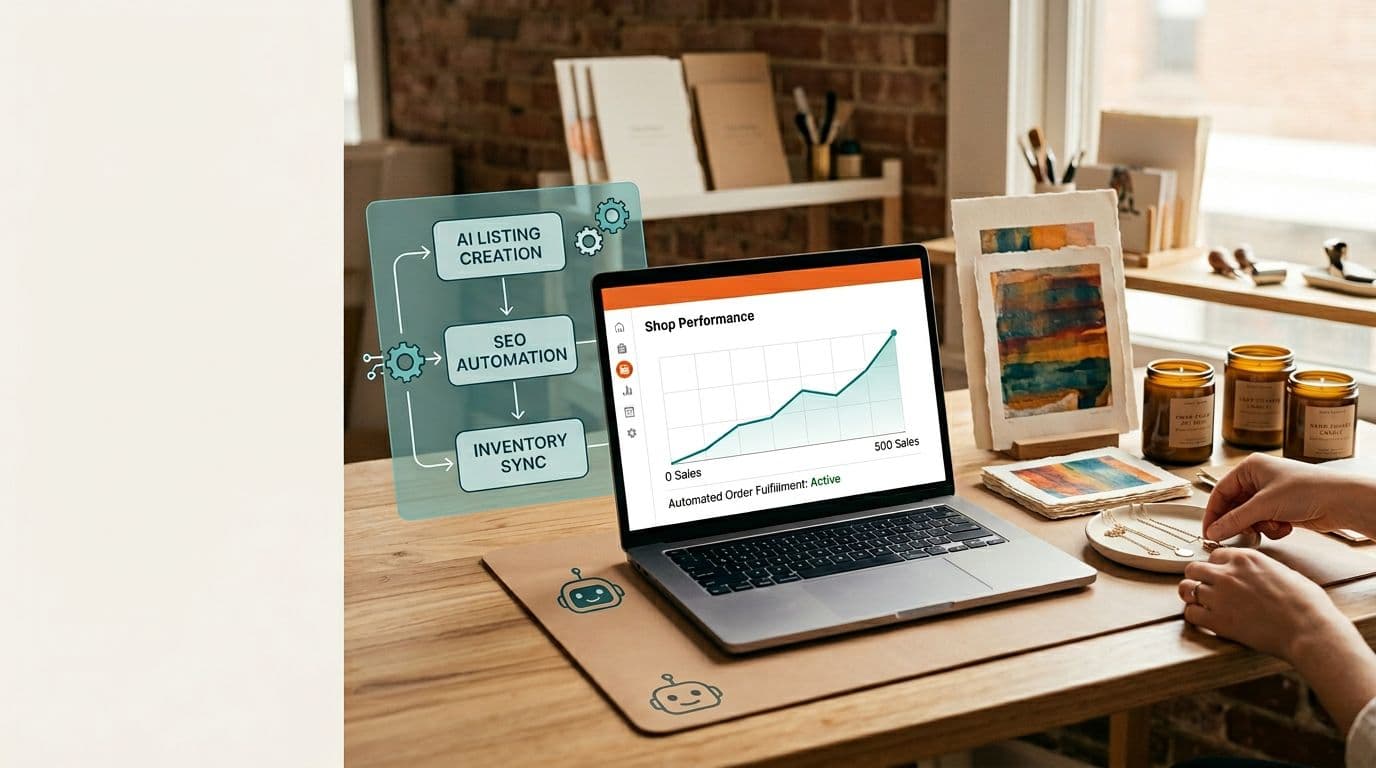
I started selling posters on Etsy because I wanted a side income that didn’t rely on client work. I quickly learned that design quality alone wasn’t enough. I could make beautiful art, but if it sat in a single listing that no one saw, it didn’t matter. What actually moved the needle was producing lots of relevant listings, getting the first image right on mobile, and shaving hours off the boring manual work of mockups and uploads. Two things made that possible for me: modern AI image models and automation that wires those images into listings at scale. Together they turned a handful of designs into a repeatable system that drove steady sales growth.
This article walks through the exact roadmap I used to hit the first meaningful milestone — 500 sales — and how you can apply the same approach. I’ll be upfront about numbers you need to model, the image models I trust, the print-on-demand partner I use for posters, and the automation shortcuts that saved me weeks of grunt work. I’ll also point out the mistakes I made and the routines I keep now so my catalog keeps growing without falling apart. If you want to grow an Etsy shop, become a reliable AI Etsy seller, or understand how Etsy automation changes the game, this is written from the trenches, not a theory paper.
The opportunity: why AI and automation matter right now
When I started scaling my shop I treated AI like a design tool, not a replacement for craft. That switch in mindset was the real game-changer. Modern image models let you generate hundreds of coherent pieces in the time it used to take to sketch one. Automation then turns those assets into live listings fast. I found that moving from 10 listings to 200 listings pushed my search impressions through the roof, because Etsy indexes every one of those keyword combinations. That’s not a guess; I watched impressions climb as my listing count rose.
Why this matters now is simple: Etsy has a huge audience — tens of millions of buyers — and it favors shops with breadth. You get more search entry points, more opportunities for long-tail keywords, and more chances for buyers to find you. At the same time fees and ad costs have tightened margins. Listing is $0.20, transaction fee is 6.5%, and Offsite Ads can add 12–15% on attributed sales. That matters because you must price and test with those numbers in mind. I priced posters so I could still make £10–£25 profit after fees and POD cost; that gave me room to buy traffic if I needed to.
I’m not saying AI replaces taste. What it does is collapse time-to-market. Instead of spending days on a single composition, I can generate five variations, pick two, tweak in Photoshop, and move on. Automation means I don’t spend hours doing mockups, resizing images, and duplicating listing fields. I’ve used automation to scale cadence from one listing a day to 30+ a week. The result: faster iteration, more tests, and ultimately a higher chance of finding winners.
Why speed matters
I learned this the hard way. When you can list 50 related variants in a week, you find the one that actually converts. If each listing takes you three hours, you won’t reach that volume. Volume is how you win long-tail search.
Why consistency matters
AI models can give you consistent series with shared style and typography. That consistency makes it easier to create collections that buyers recognise, which helps with cross-sells and repeat purchases.
Why automation matters
Automation cuts the busywork. Once you have a repeatable pipeline, you can focus on the two things that move revenue: finding keywords that convert and improving listing conversion for the impressions you already have.
Reading the market signals that shape your strategy
You can’t grow a shop in a vacuum. I watch three sets of signals: buyer demand, fee pressure, and platform tooling. Buyer demand is straightforward. Categories like personalized wedding goods, sustainable home decor, and prints have been holding or growing. Mobile traffic is huge — a majority of buyers browse and buy on phones — so every listing has to read and sell on a small screen. That affects how I write titles and choose which photo becomes the first image.
Fee pressure affects pricing decisions. Listing fees are small but consistent. The 6.5% transaction fee and payment processing add up. Offsite Ads can be an easy way to get early visibility, but you must model the 12–15% hit for attributed orders. I run simple unit-economics spreadsheets for every SKU. If a poster’s POD base cost is £11.49 (Printshrimp’s A1 example), I price so my net is at least £10 after fees. Why £10? Because it gives me wiggle room to run ads and still make profit.
Platform tooling matters because Etsy keeps shifting what helps with visibility. Their public investments in creator tools and short-form video mean that shops that adopt video and UGC early get rewarded with higher CTRs. I test short-form clips for new designs before listing widely. If a clip gets strong early traction, I scale that design across sizes and mockups. If it flops, I retire it fast.
What the data says about volume
Conversion benchmarks matter. Typical shops convert around 1–3%. Strong niche listings can hit 4–8%. That means to reach 500 sales you need a mix of traffic and conversion improvement. You can buy traffic, yes, but the long-term win is higher organic impressions through more listings and better CTRs.
What to watch week by week
If you set up tracking from day one, you’ll see which listings get impressions but not clicks, which get clicks but not conversions, and which convert well. That’s where your energy should go. For me, visits without conversion pointed to a bad first image or shipping ambiguity.
Why model everything
I weight pricing decisions with worst-case ad spends. If Offsite Ads attribution bumps my ad cost to 15%, can I still make profit at my price? If I can’t, I change price or packaging, or I don’t scale that SKU.
Week 0–2: foundations, legal checks, and shop setup
The first two weeks are boring but essential. I always start with four setup tasks: confirm model licensing, create a unit-economics spreadsheet, order samples from your POD partner, and set up tracking. If you skip licensing, you risk takedowns. I keep a simple log: model name, model tier, prompt text, and any post-processing edits. That record saved me once when a buyer asked about provenance.
The unit-economics spreadsheet is where real decisions happen. I list base cost by size, Etsy fee scenarios, and a few Offsite Ads percentages. For posters I use Printshrimp’s price examples and calculate profit at retail prices I actually intend to use. For a common approach I price an A2 at roughly £34.99 and A1 at £44.99 because those points give me room for fees and occasional ad spend.
Sample orders are non-negotiable. Print quality, shipping times, and how mockups translate into reality matter to conversion and returns. When I started, I ordered three sizes and took my own lifestyle photos. Buyers trust real photos more than an overly staged mockup.
Finally, set up your shop metadata properly. Fill every attribute, use accurate item-type fields, and pick the right production partner. Etsy uses these fields for filters and ranking, so treat them like keywords.
Confirm model licensing
Be explicit. I use only models with clear commercial terms and keep a short log for each generated asset. That log has saved me the headache of proving rights when I refreshed listings months later.
Build your economics spreadsheet
Include POD cost, shipping, Etsy fees, Offsite Ads scenarios, and target profit. I aim for a minimum of £10 net margin on poster sizes so I can run paid tests without losing money.
Order physical samples
You’ll notice small differences between mockups and product photos. Those differences affect returns and reviews. A single bad return can damage a new shop’s reputation.
Weeks 2–6: build catalog fast without sacrificing quality
These weeks are where most sellers stall, because they try to perfect a single listing. I did that too. The faster route is to pick a focused niche and generate many variations. If you specialise — say botanical dining prints — you can build 20–50 listings that target different keywords: "botanical kitchen print," "herb wall art," "culinary herb poster" and so on. Each listing should be mobile-first. Put the best keyword in the first 40 characters of the title. Use all 13–20 tags and fill attributes thoroughly.
Design-wise, I use prompt templates to batch-produce 5–10 variations per concept. That gives me a selection set to refine. I don’t publish everything I produce. I curate. The trick is to automate the grunt work (resizing, mockups, uploading) but keep a human curation step before live listing. Automation without curation just creates noise.
For mockups, I mix studio and lifestyle images. One lifestyle shot, one scale shot, and a close-up are essential. Include a short video where practical. I’ve found videos boost CTR and conversions because buyers get a better sense of scale and texture.
Batch generation and prompts
I save prompt templates with placeholders for color, keyword, and style. That lets me replace just one variable and produce a dozen on-brand designs quickly. Keep a prompt+edit log for each SKU so you can reproduce or refine later.
Mockups and the first image
The first image decides if a buyer clicks. I choose a clean lifestyle shot with clear text hierarchy and a single focal point. If the design includes text the mockup must show it legibly at mobile size.
Automation for uploads
This is where I regained time. Using automation I bumped my cadence to 30 listings a week by automating mockup creation, resizing, and field population. That automation frees time for testing titles, prices, and the first image. This is exactly why we built Artomate — to automate the mockup-to-listing pipeline so you can focus on what actually moves sales. If you’re doing more than a handful of listings a week, automation pays for itself in days.
Weeks 6–26: scale, test, and double down on winners
Once you have your initial catalog, it becomes a math problem: invest time and ad dollars into what shows demand, kill what doesn’t, and scale winners. My rule of thumb: if a listing gets impressions and a CTR under 1% after a week, try a new first image and tweak the title. If after two iterations conversion stays low, retire it and recycle the design into a different angle. Don’t be sentimental.
I run weekly A/B tests on first image, title (first 40 characters), and price. Tests don’t need to be fancy. I swap the first image in a duplicate listing and compare traffic and conversion. For price I test £2–£3 differences on posters. I’ve regularly found that a small uptick to £12.99 from £9.99 increases margin without killing conversion, because buyers associate price with perceived quality.
You’ll also tune marketing mix. I use a combination of controlled Etsy Ads and creator content. Short-form video is my early signal test. If a video brings clicks and saves, I boost that listing with a small Etsy Ads budget. I model Offsite Ads into that test so I understand real net profit after attribution fees.
Iteration cadence
Weekly rule: look at listings with visits >50 and conversion <1%. Those are the ones that deserve the first-image treatment. If visits are low, focus on tags and title changes to increase impressions.
Scaling winners
When something works, create variants. Different sizes, colorways, and product types often sell. I use automation to clone the listing, change size and price, and push the new SKU live fast.
When to spend on ads
I only increase ad spend on listings that already convert organically. Paying to validate a design works is fine, but I don’t pay to validate something that hasn’t shown basic organic traction.
Tools and platforms I actually use (models, POD, automation)
I’m picky about tools because I’ve had to carry the operational cost when something breaks. For image models I use the ones that give predictable, repeatable results and clear commercial terms. My go-to list: GPT Image 1.5 for precise composition, Nano Banana Pro and Nano Banana 2 for studio-quality control and better text rendering, and Seedream 5.0 Lite for high-res stylised outputs. Stable Diffusion 3 family is an option if you want self-hosting and fine-tuning, but check license details carefully. I don’t recommend Midjourney or Adobe Firefly for this workflow.
For posters I picked a POD partner that didn’t quietly add shipping costs. Printshrimp has been my default for posters because an A1 at about £11.49 including shipping means I can price at £34.99–£44.99 and keep healthy margins. Printshrimp’s paper and dispatch times beat alternatives in my tests. For other product types you can use Printful or Printify, but I revert to Printshrimp for art prints.
For automation I use tools that automate mockup generation, bulk listing creation, and SEO field population. This is where most of my time savings came from. Automation lets me go from a finished image to a live, SEO-optimized listing in minutes. If you’re serious about Etsy shop growth, invest in automation early. This is exactly why we built Artomate — to handle AI generation, mockups, SEO-optimized listing text, and bulk uploads so you aren’t stuck copying the same fields over and over again.
Quick tools list
- Image models: GPT Image 1.5, Nano Banana Pro, Nano Banana 2, Seedream 5.0 Lite
- POD: Printshrimp for posters; Printful/Printify for other SKUs
- Automation: automation that creates mockups and populates listing fields (see Artomate pricing link above)
Why these choices
I pick tools with transparent commercial terms and predictable outputs. Predictability lets you automate. When the model and POD behave consistently, you can script and scale without firefighting.
Common mistakes sellers make and how I recovered from them
I learned a few lessons the painful way. First, ignoring licensing is a rookie error. Early on I used a model without checking the tier, and I had to rework a set of listings. Now I log model name, tier, and prompts. I keep that log with my product metadata so I can defend rights if needed.
Second, sellers under-invest in listing volume. I used to perfect single listings. That slowed discovery. The mass-listing approach sounds unromantic but it works because Etsy indexes everything. Once I accepted that I needed dozens to hundreds of listings, my impressions and opportunities rose.
Third, poor first images kill traffic. I re-shot dozens of mockups before I stopped guessing. One clear lifestyle image, shown at real scale and legible on mobile, raised CTRs noticeably. If your first image is cluttered, buyers will scroll past.
Fourth, skipping A/B testing leads to false conclusions. I once gave up on a design after one bad week. Later I re-listened with a new first image and it became my top seller. Test changes in small steps and give them time.
Over-automation without QC
Automation saves time but it also amplifies mistakes. I once bulk-listed 40 variants that had a typo in the title because I didn’t check the template. Now I always have a human review step before publishing batches.
Not modeling fees
A seller can be profitable on paper and still lose money after Offsite Ads hits. Always test with worst-case fee scenarios so you don’t scale a loss-making SKU.
Patterns from shops that hit 500+ sales (benchmarks and what they do the same)
When I studied shops that reached 500 sales, patterns popped up repeatedly. First, they start narrow and go deep. A shop focusing on a specific occasion or aesthetic will create dozens of micro-variants that capture long-tail searches. That niche depth drives consistent traffic.
Second, they automate and iterate fast. Successful shops don’t treat listings as static; they test images, titles, and small price moves weekly. I tracked conversion improvements by instrumenting a simple spreadsheet and measuring lifts from one change at a time. Little wins compound.
Third, visuals and video are non-negotiable. Listings with 7+ photos and at least one short video outperform those without. Video reduces buyer uncertainty about size and texture, which lowers returns and increases conversion.
Fourth, they document operations. From prompt logs to fulfillment SLAs, documentation reduces mistakes and speeds onboarding if you scale the team. I keep a living document that records POD partner contact info, expected dispatch windows, and a response script for returns.
Benchmarks I use
- Conversion: baseline 1–3%, aim for 2–4% through iteration
- Listings: initial goal 50–200 within 2–3 months, 500+ over 6–12 months for serious scale
- Profit: £10–£25 per poster after fees and POD costs is a sweet spot for me
How they scale winners
When a variant works, they clone it across sizes and finishes rapidly and push modest ad budgets behind it. Because margins are modelled, ad spend can be justified and scaled without gambling on unknowns.
SEO and discoverability for 2026: practical tactics I still use
Etsy search is simple in concept: relevancy plus signals. In practice that means you must get keywords, images, and activity right. I put the best keyword in the first 40 characters of the title because mobile users see that first. Tags get all the synonyms, recipient and occasion words, and material keywords. Attributes and item-type fields get treated like tags; fill them accurately.
Images are part of SEO indirectly because they affect CTR. Listings with strong CTRs get ranked higher. I treat the first image as prime real estate and test versions often. Also, include at least one short product video. Videos move CTR and conversion.
For Google traffic I write descriptive long-form descriptions that include natural phrases a buyer might search. Etsy’s public pages are indexed, so those long descriptions help off-platform discoverability. I also use small creator pushes and backlinking from social posts to build a tiny external signal.
Tools for keyword research
I use eRank and InsightAgent to spot long-tail phrases with low competition. Those tools helped me find surprisingly cheap keywords where I could rank quickly. When a phrase has consistent search volume but low competition, I prioritise it for quick listing tests.
AI disclosure and buyer trust
Etsy recommends disclosure for AI-generated content. Enforcement has historically been light, but I include a short line in the description saying which models I used and that designs were generated and refined. That small transparency reduces buyer confusion and builds trust.
Iterate on SEO
Every two weeks I look for listings with impressions but low clicks. That’s usually a title or first-image problem. Fix those two things and you’ll see quick gains.
Future outlook and how I’m preparing my shop
I watch three trends closely: better AI fidelity, improved creator tooling from Etsy, and tightening unit economics. Model quality keeps improving which means design friction will drop, but competition will rise. That’s why process matters more than ever. I’m investing in repeatable prompt templates and a strong prompt+edit log so I can reproduce or tweak winning designs quickly.
Etsy will likely surface more creator features and video capabilities. I plan to double-down on short-form content that validates product-market fit before heavy listing investment. Operationally, automation will keep taking over more tasks — not just mockups but routing orders to different POD partners and handling returns. I keep a playbook for multi-POD setups so I can switch quickly if a partner’s pricing or dispatch changes.
License and IP risk will remain a factor. My rule is simple: use models with clear commercial terms and keep detailed records. That approach reduces surprise work and helps me sleep.
What I’d do differently next time
Start automation earlier. I waited too long because I wanted perfect control. If you’re serious about Etsy shop growth, put automation in place before you hit 50 listings. It pays for itself faster than you expect.
Long-term bets
I’m investing in systems to capture off-platform traffic: email, TikTok, and small creator partnerships. Once you get repeat buyers, your lifetime value changes the math for ads and product development.
FAQs I answer for sellers trying this path
Do I have to disclose AI usage on Etsy listings?
Etsy asks sellers to disclose AI usage, and I do a short line in the description. Enforcement has been inconsistent as of 2026, but disclosure builds trust. I say: "Generated with AI, refined by hand" and link it to a short note on how I produce prints.
Which image models should I use for print-on-demand?
Use the models I mentioned earlier: GPT Image 1.5, Nano Banana Pro, Nano Banana 2, Nano Banana, and Seedream 5.0 Lite. They give predictable commercial results and better text rendering. If you need local control, Stable Diffusion 3 family is an option, but check the license.
What POD partner should I use for posters?
I recommend Printshrimp for posters. Their A1 pricing around £11.49 including shipping gives margins that let you price competitively and still make £10–£25 per sale depending on size.
How many listings to reach 500 sales?
There’s no exact number, but plan to reach 100–200 listings within a few months and scale winners. Many sellers hit 500 sales as they pass several hundred active SKUs because volume increases the number of indexed keywords and buyer touchpoints.
Should I use Offsite Ads?
I test them, but only when I model the attributed fee into unit economics. They can accelerate early traction, but don’t forget the 12–15% attribution hit on some orders.
Final Thoughts
If you want to grow an Etsy shop from zero to 500 sales, treat it like two problems: create enough relevant listings and get those listings to convert. AI shortens design time, automation shortens listing time, and disciplined testing improves conversion. I built my process around predictable models, a POD partner that didn’t surprise me on shipping or paper, and automation that removed repetitive tasks so I could focus on titles, photos, and testing. Start small, instrument everything, and automate the boring parts early. The first 500 sales are mostly about systems, not brilliance.

George Jefferson
Founder of Artomate
George has generated over £100k selling AI-generated posters on Etsy and built Artomate to automate the entire print-on-demand workflow. He writes about AI art, Etsy strategy, and scaling a POD business.
Learn more about me →