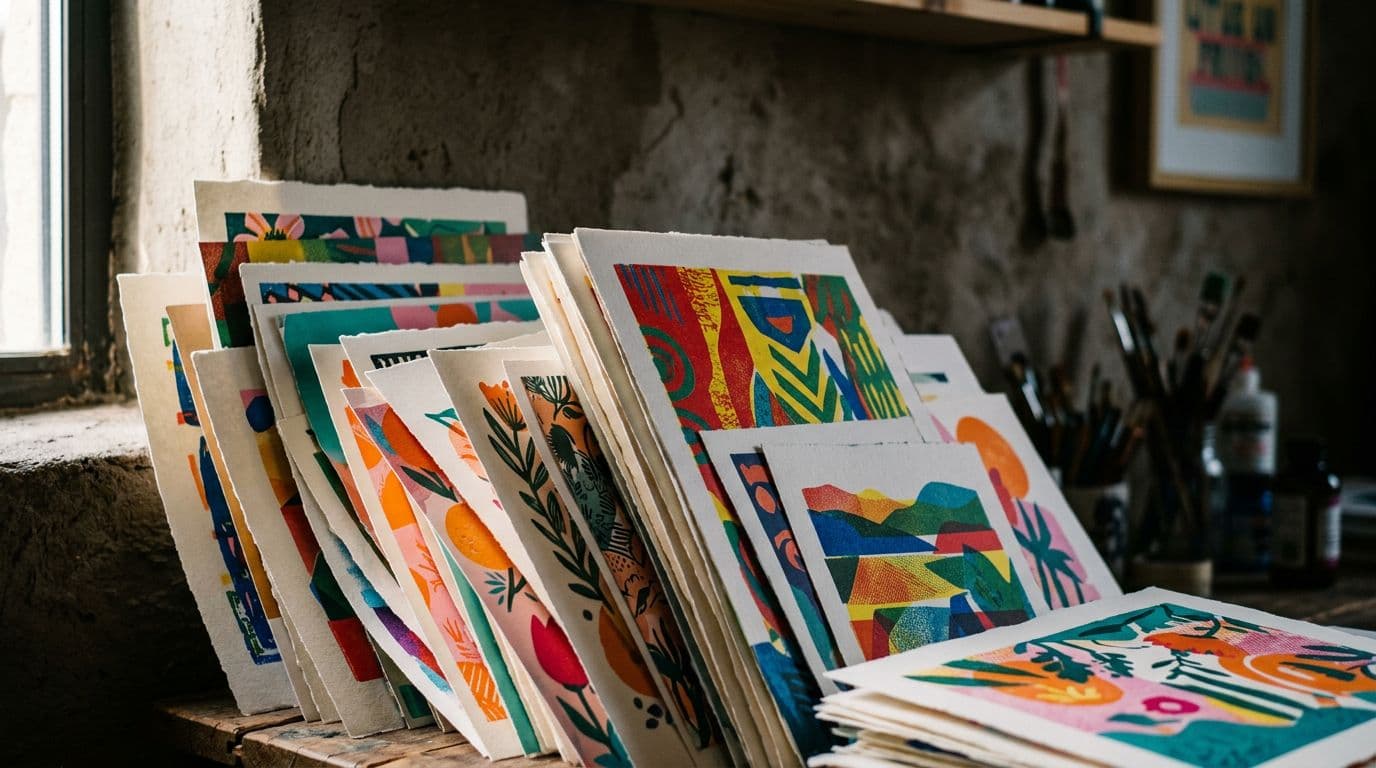
Gaming Poster Art on Etsy: Create Posters Gamers Actually Want

I remember the first time I tried selling a gaming poster on Etsy. I thought a cool fan-style layout and a cheap mockup would be enough. It wasn't. Views trickled in, but conversions didn't follow. After a year of testing designs, POD partners, and pricing, I found a repeatable way to build posters that gamers actually buy: designs that understand the room they're bought for, margins that survive Etsy fees, and mockups that show the poster in a streamer or gamer setup rather than floating on a blank background. The good news is the market still responds to this approach. The hard news is you have to accept two realities: copyright risk around direct character art, and the math of Etsy fees plus shipping.
This article is the playbook I wish I'd had when I started. I'm writing from the shop floor — the experiments, the failed SKUs, the winners — and I'm naming exact models, partners, and numbers I use. If you're building a gaming poster line on Etsy, you'll get a step-by-step plan to go live fast, which POD partners to favour, how to price so you actually make money, and what to avoid to keep your listings live. I also explain when automation pays for itself and why a tool that automates mockups and bulk listings changes everything once you've found a winner.
Why this niche matters right now
Gamers buy posters. A lot. They've spent years personalizing streaming setups, bedroom walls, and gaming rooms, and they want art that reflects the games they love or the mood they stream in. I watched this trend move from hobby purchases to consistent, repeatable orders in Q4s and around big releases. Etsy remains one of the best marketplaces for indie art and lifestyle decor, and the platform's search still rewards shops that offer many relevant entry points. That creates a real opening: demand is steady and the cost to produce and list has fallen because AI generation and POD fulfillment make iterations cheap.
But there are two hard constraints you can't ignore. First, legal risk. Since 2025 I've stopped uploading anything that directly reproduces trademarked characters unless I hold rights. Studios and content owners are actively pursuing enforcement and the U.S. Copyright Office's stance on fully AI‑generated registration is weak. Second, the math. Etsy charges $0.20 per listing, takes 6.5% transaction fees and roughly 3% plus $0.25 on payments in the US. Offsite Ads can add 12–15% on attributed orders. I price with those numbers in mind every time I create a new SKU.
Here's how I think about it: this niche rewards volume and speed of iteration, because the algorithm likes many listings and buyers like lots of options. That makes automation valuable, but automation won't save a poor design or bad margin math. You need design that sells, fulfillment that keeps costs low, and listings that convert.
H3: Demand proof from my shop
I've tracked a handful of designs that consistently sell after I improved their mockups and price points. Digital downloads acted as my testing ground — low friction, fast feedback. Designs that hit a 2–3% conversion as downloads usually convert at 1.5–2% when I add physical prints, if I get the photos and shipping right. That's how I scaled a small test catalog into hundreds of listings.
H3: The IP reality I built my shop around
I stopped posting anything that uses direct character likenesses in late 2024. Instead I focus on original, game‑inspired concepts: stylized maps, minimalist silhouettes, typographic quotes that avoid exact lines from scripts, and retro arcade aesthetics that feel nostalgic rather than derivative. That approach reduces takedown risk and still resonates with buyers.
H3: Why shipping and listing math matters
A $12 poster can convert well, but if its shipping is $8, most buyers won't click buy. I bake shipping into price for US orders whenever I can, because Etsy tends to favor listings with lower visible shipping costs. That small change alone lifted conversions across several SKUs by a noticeable margin.
Market trends and what the data shows
If you pull a sample of Etsy search pages for "video game posters" or "gaming poster Etsy" in 2026 you'll see a predictable spread: digital downloads clustered between $2 and $15, printed posters from roughly $12 to $40, and framed or bundled sets pushing up to $120. That matters because shoppers expect tiered options: cheap quick-downloads for instant gratification and higher‑AOV physical prints for gifting or room decor. I price digital files low to test concepts and use winners to invest in printed runs.
Conversion in this niche follows platform averages — think 1–3% for most listings, with the very best reaching above 3%. Shops that hit those higher numbers usually follow a similar blueprint: strong mockups, fast fulfillment, and pricing that survives Etsy fees. Another trend I see every month is the algorithm favouring shops with many listings. Top sellers often have 500–2,000 listings, which gives them more keyword indexation and more opportunities to show up in search.
AI generation improved meaningfully in 2025 and through 2026. Models now deliver print‑ready detail and better type handling, but licensing clarity varies. I stick to recommended models with commercial terms I trust to avoid surprises. On the POD side, pricing that includes shipping is a huge advantage when you want predictable margins.
H3: Pricing and product mix I recommend
From my analytics, a good starter product mix is 6–12 designs offered as digital download plus printed posters in 16x20 and 18x24. Price digital downloads at £3–£9 and physical posters in the £12–£34.99 range depending on size, with a framed or canvas option that boosts AOV. Selling at roughly 2–3× POD cost is a sensible starting point, but always run the numbers against Etsy fees and ad spend before you lock prices.
H3: Traffic channels that actually move the needle
Pinterest and TikTok deliver the discovery traffic for gamer wall art. I use short clips showing mockups in streamer setups and Pinterest pins styled for gaming rooms. Those platforms drive a steady trickle of clicks that convert at a similar or slightly higher rate than Etsy Ads when you target the right audiences.
H3: What the market is telling me about IP and AI
Legal pressure on AI training data is real. I watch cases and Copyright Office updates because they change how safe it is to upload generative fan art. Practically, that means avoid exact character recreations and favor original concepts or licensed artwork if you want to sleep at night.
Research and keyword planning — how I pick keywords that sell
I spend 2–4 hours on keyword work for each new line. That doesn't mean obsessing over every phrase. It means identifying 6–12 long‑tails with clear buyer intent and manageable competition. For gamer wall art I search terms like "gaming room poster," "retro arcade poster 18x24," and "video game art Etsy." I use eRank and Marmalead when I have them, but you can do a lot for free by sampling Etsy's SERP and noting recurring title patterns and tags.
My rule of thumb is to prioritise long‑tails that match a clear use case: streamer backdrop, gaming room decor, gift for gamer, or specific room sizes. Titles put the primary buyer keyword at the front. Tags fill in variations and attributes, and attributes themselves are useful for Etsy's filtering. I write titles readable by humans first, search-friendly second. That balance helps conversions.
H3: How I choose my 6–12 long‑tails
I start with a shortlist of 20 candidate phrases pulled from SERP patterns and tools. Then I score them by intent (does the searcher want to buy?), competition, and how unique my design angle is. A long‑tail like "retro arcade poster 18x24" is attractive because the size is explicit and the intent is buying. Those long‑tails become landing keywords for each SKU.
H3: Tagging and attributes — what I actually do
I use all 13 tags and make sure to include size, room, and recipient attributes. For example, tags for a streamer-focused poster might include "gaming poster," "streamer backdrop," "gamer wall art," and "gaming room decor." Attributes such as room (bedroom, office) and recipient (gamer, streamer) amplify discoverability in Etsy's filtering.
H3: Quick title formula I use
My titles lead with the primary phrase, followed by style and audience. For example: "Gaming Room Poster 18x24 – Retro Arcade Print for Streamers – Gamer Wall Art." It's readable and puts the buyer phrase up front. That single change improved CTR on several listings for me.
Design and production workflow that keeps me shipping winners fast
Design is where most sellers stumble. They either overcomplicate things or copy obvious fan art. I treat design as an iterative funnel: quick prototypes, cheap tests, then polish winners for print. I build print‑ready files at 300 DPI for common sizes and keep aspect ratios ready so I can export for multiple SKUs without recreating the whole piece.
I use Tier‑1 image models for initial assets: GPT Image 1.5, Nano Banana Pro and Nano Banana 2, and Seedream 5.0 Lite. These deliver consistent composition and text readability, which saves me hours of cleanup. I always start with a brief that includes target sizes, colour palette, and reference images so the model gives a predictable result. Then I edit in Photoshop or Affinity to fix alignment, tweak typography, and export bleed‑safe PDFs.
H3: My prompt and reference strategy
I use layered prompts: mood, composition, focal points, and paper texture. I include 2–4 reference images where needed to keep a consistent aesthetic across a line. That means if I want a retro arcade series, all pieces share palette and grain, and they look like a curated set rather than random outputs.
H3: File prep and sizes I always export
I prepare master files at 300 DPI in the largest poster size I plan to sell, often 24x36 or A1. From that master I export 11x17, 16x20, 18x24 and 24x36 variants. That lets me offer multiple SKUs quickly. I also save a flattened JPEG for mockups and a high‑res PDF for the POD provider.
H3: How I test looks quickly with samples
Before I list a new design, I order two physical samples from my POD partner: one mid‑size and one large. I check colour, paper texture, cropping, and shipping time. Those samples often reveal small but contract‑breaking issues like colours shifting or misaligned margins, which you only notice in hand.
Fulfillment and POD partners — what I use and why
Posters have unusually thin margins if you ignore shipping. That's why I favour POD partners that include shipping in their pricing. For posters, my top pick is Printshrimp. Their A1 poster at about £11.49 including shipping is a game leveler. I can safely list that product at £34.99 and expect roughly £20+ profit after Etsy fees and payment processing if I keep ads modest. Printshrimp's paper options — 200gsm museum‑grade in satin, matte or gloss at no extra cost — make the product feel premium without a premium base price.
I still use Printful or Printify for other products where Printshrimp doesn't have coverage, but I always compare the landed cost including shipping. Gelato occasionally wins for specific regions. The practical step is to test two providers in parallel for 2–4 designs to compare colours and dispatch times.
H3: Why I avoid a single provider lock‑in
One fulfillment partner can be a weak point if they have a quality slip or shipping delay. I maintain a small secondary POD account so I can shift volume quickly if needed. That redundancy cost me nothing major but saved a launch once when a single production hub had delays.
H3: How I model POD costs into price
I keep a spreadsheet: POD price + included shipping, Etsy listing $0.20, 6.5% transaction fee, payment processing (~3% + $0.25 US), and an assumed ad spend per sale. I target 30–50% net margin on physical posters. That buffer pays for returns, occasional discounts, and still leaves a viable profit.
H3: Sample ordering cadence I recommend
Order samples for every new design and any time you change a file. I order a sample of every new size before I list it. If you launch 10 designs, that's 20–30 samples — expensive up front, but it prevents bad photos and costly returns down the line.
Listing creation, mockups, and photos that actually convert
Posters sell on emotion. If your hero photo doesn't show the poster in a gamer room or behind a desk with an RGB setup, most buyers mentally downgrade it to 'generic art' and move on. I hire a photographer once for three styled scenes: a streamer desk, a bedroom wall, and a living room media wall. Then I reuse those scenes as mockup templates to present multiple prints. That consistency makes a shop feel curated and professional.
My listing image set includes: a large hero styled room shot, a scale photo with a person or furniture for size reference, a texture closeup showing paper grain, a framed option shot, and a lifestyle image showing the poster in a stream or setup. I also include a simple infographic image that lists product specs and shipping info. Those images together push CTR and conversion because they answer buyers' questions visually.
H3: Mockup generation process I use
I automate mockups wherever possible so I can create 6–12 images for each variant without manual work. For mockups I use a set of layered PSD templates and swap in high‑res flattened JPEGs. That way a winning design can be exported to all mockup scenes in minutes rather than hours.
H3: Text and description that sells
Write the first 1–2 lines for skimmers: size, paper, and a quick use case, such as "Perfect for streamer backdrops and gaming room walls." Then expand into a short designer note about inspiration and care instructions. Keep it human and specific. Buyers care about what the piece is for and if it will arrive quickly.
H3: Why I show shipping upfront
I display expected dispatch and shipping times near the top of the description and in an image. Fast shipping and clear expectations cut returns. For US listings I bake shipping into the price where possible to appear cheaper in Etsy search filters.
Pricing, fees, and the margin math I run every time
Every new SKU runs through the same calculator. My inputs are POD base price (including shipping if provided), Etsy listing fee $0.20, transaction fee 6.5% of the retail price, payment processing (I use 3% + $0.25 as an estimate for US), and an estimated marketing spend per sale. If you're doing Offsite Ads, add 12–15% for attributed orders. I aim for a 30–50% net margin after those costs for printed posters. Digital downloads are easier — margins often exceed 70% after Etsy fees because the base cost is near zero.
For an example, a Printshrimp A1 that costs £11.49 shipped and sells at £34.99 looks like this in my sheet: retail £34.99 minus POD £11.49 minus listing $0.20 converted to GBP, minus 6.5% transaction, minus payment fees. After the math I still get roughly £20+ profit before ads. That margin buys me testing budget and occasional discounts without going negative.
H3: Pricing tactics that work
I test two price anchors: a mid‑range price that maximizes buy intent (often the best performer for posters) and a higher price that positions the piece as premium. For many pieces the mid price is the sweet spot. On digital bundles I use volume pricing — three related downloads for a slightly discounted bundle to increase AOV.
H3: Shipping strategies I use
If shipping is reasonable, I bake it into the price and show "free shipping" on Etsy. Where shipping is high, I offer a shipping discount for single order add‑ons or a combined shipping rule. The visible shipping cost affects search filters and buyer psychology, so don't ignore it.
H3: Building ads into the margin
I assume an initial CAC of £1.50–£5 per conversion depending on the niche and competition. That baseline helps me decide how much I can spend to get a design in front of buyers. If a design can't pay for profitable ad testing at that CAC, I shelve it.
Scaling, automation, and the moment you should invest in tools
At about 10–20 proven SKUs you hit a tipping point where manual mockups and listing creation become a bottleneck. That's when I automate. For me, automation meant creating templates, scripting exports, and eventually using tools that generate mockups and publish listings in bulk. That step transformed my business because Etsy rewards scale: more listings equals more keywords indexed and more chances to be found.
I helped build a tool to solve that exact problem and we use it in my workflows. Tools like Artomate automate mockup creation and bulk listing publishing so you can scale without burning time on repetitive tasks. I only turned to automation once I had validated winners. The tool paid back its cost within weeks because I could create 50–100 new listings in a few hours instead of weeks.
H3: When automation pays for itself
Calculate the hours saved versus the tool cost. If you spend 6–8 hours creating a single listing manually and expect to scale to 100 listings, automation that saves even half the time is worth the subscription. I usually reach this point once I have 10–20 winners and plan to expand sizes, colorways, and mockups.
H3: How I structure replication and variations
Once a design proves itself, I create variations by size, colorway, framed vs unframed, and digital bundle. Automation lets me clone the listing metadata and swap images quickly. That incremental effort drives most of my catalogue expansion.
H3: Maintain quality as you scale
Automation shouldn't make listings bland. I still check hero images and tweak descriptions for top performers. Human oversight on the first 20 clones catches context errors that would otherwise tank CTR.
Common mistakes and legal traps I've seen — and how I avoid them
I've watched sellers build nice traffic only to get hit by takedowns or margin collapse. The most common mistake is selling direct character fan art without license. Since 2025, studios and IP holders have been more active, and the Copyright Office has made it clear that fully AI‑generated works have shaky registration protections. I protect my shop by avoiding exact character reproductions and by creating original, game‑inspired pieces.
Another frequent error is sloppy margin math. Sellers list a £12 poster with £6 shipping and assume it will sell; after Etsy fees and payment processing there's little left. I model the full cost before listing anything and adjust price or shipping accordingly. Poor mockups and photos are another killer. If your hero image is a low‑quality PNG on a blank wall, you will not convert like someone who shows the piece in a streamer setup.
H3: Copyright rules I follow
I avoid using copyrighted logos, character likenesses, or direct lines from games. If I want to reference a franchise, I either get permission or make it an original homage with distinct visual language. That lowers risk and keeps my listings visible.
H3: Shipping and fulfillment traps
Don't assume the cheapest POD partner is the best. Low base cost plus high shipping kills margins. I insist on landed pricing for posters whenever possible and maintain at least one backup fulfillment partner.
H3: Listing and SEO mistakes I see often
Not using all 13 tags, ignoring attributes, and writing titles for algorithms rather than humans are basic errors. Those small fixes are often the quickest way to lift impressions and CTR on underperforming listings.
Future outlook and how I plan for it
Expect image models and automation to keep improving. That makes iterating faster but also increases the volume of competing listings. The short term will bring more print‑ready AI assets and faster POD networks. Over the next couple of years POD will localize more, reducing shipping times and improving margins for sellers who optimize regionally.
Legal pressure around AI and IP is the largest wild card. I expect studios to continue protecting their assets and for platforms to tighten rules. My bet is on original design approaches and licensing partnerships for anyone who wants to commercialize character art safely. For solo sellers, that means leaning into stylized homages and original concepts.
H3: Business moves I'll prioritise
I'll keep investing in automation and mockups, keep my POD relationships flexible, and keep a product mix that balances digital downloads and printed posters. If a model or partner offers clearer, safer commercial terms, I'll move quickly because legal clarity reduces risk.
H3: Why margins will win over trends
Short‑term trends come and go. What survives is a seller who controls cost per unit and conversion. That means choosing the right POD partner, baking shipping into price where needed, and maintaining ad discipline. I plan to double down on whatever keeps unit economics healthy.
H3: How I'll watch policy changes
I read policy updates and legal news regularly and adjust my catalog when I see risk rising on a particular design style. If studios start aggressively policing a certain aesthetic, I stop producing it and adapt. That flexibility keeps my shop live and profitable.
Final Thoughts
If you want to sell gaming posters on Etsy, do the hard work up front: research long‑tail keywords, design originals that avoid clear IP problems, and test as digital downloads before you invest in print. Order samples, polish mockups for gamer rooms and streamer setups, and run the full margin math with Etsy fees and offsite ad risk baked in. When you have winners, use automation to scale — that’s where tools like Artomate come into play.
I built my poster line the slow way, learning which mockups convert and which price points collapse under fees. You can shortcut that learning curve by testing fast, keeping an eye on IP risk, and preferring POD partners that include shipping in the base price. Do that and you'll have products gamers actually want, a shop that grows, and margins that let you reinvest.

George Jefferson
Founder of Artomate
George has generated over £100k selling AI-generated posters on Etsy and built Artomate to automate the entire print-on-demand workflow. He writes about AI art, Etsy strategy, and scaling a POD business.
Learn more about me →