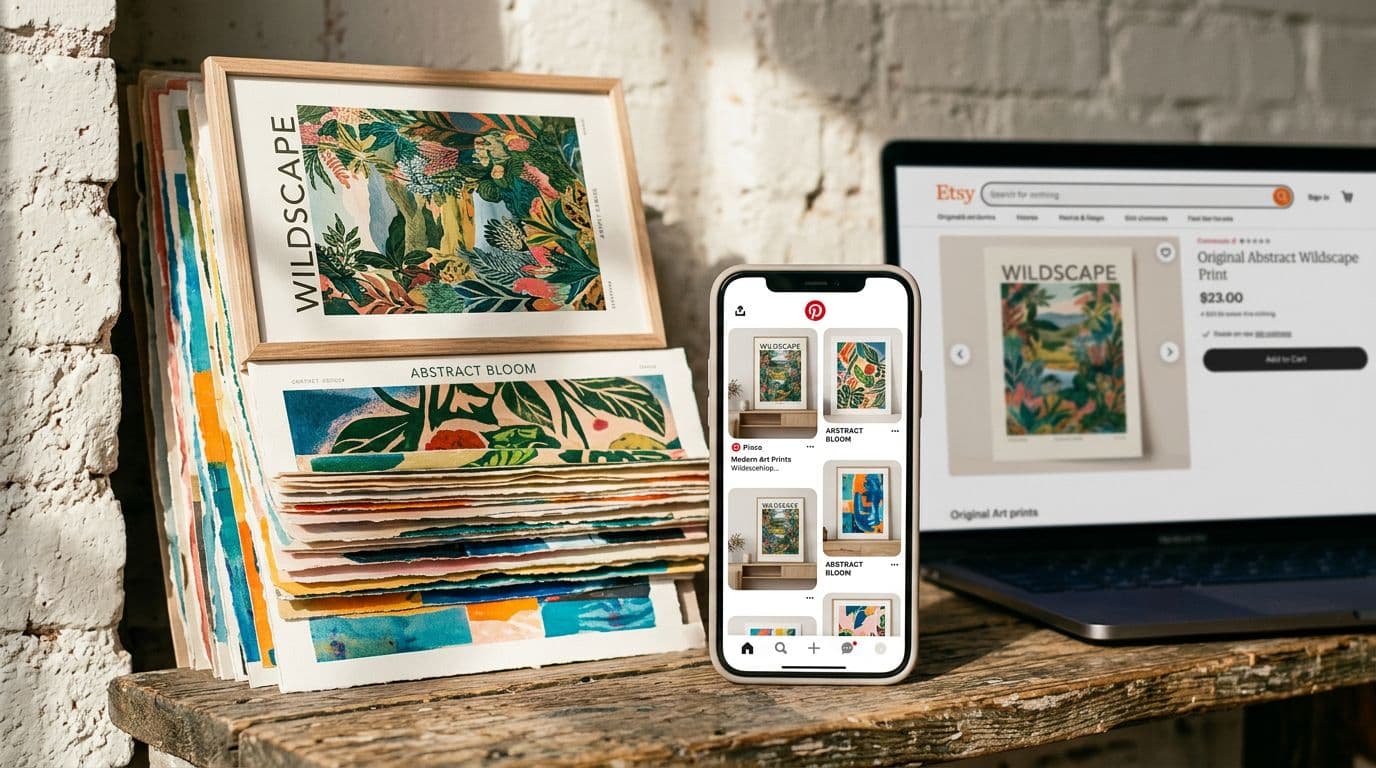
Etsy SEO in 2026: What Actually Ranks for Poster Sellers

I remember the moment I realised Etsy had stopped being a keyword lottery. I was testing three identical poster designs with slightly different titles, and the one that used natural language and showed a clear use case in the title started getting clicks overnight. Not because I stuffed more tags, but because the thumbnail and copy matched what buyers typed and what they wanted to see. That shift matters if you sell print-on-demand posters, because the platform now combines semantic matching with real behavioural signals. In plain terms: Etsy first decides if your listing even belongs in the candidate pool using LLM-style semantics, then it rewards listings that actually convert. If your listings read like a robot and your mockups look like clip art, you can rank keywords perfectly and still lose to better-converting listings.
This article is a practical playbook from someone who’s built, tested, and scaled poster lines on Etsy. I’ll walk through the market signals I watch, the exact listing changes I make, the models and POD partners I trust, and the automation tricks that let you scale testing without burning weeks creating mockups by hand. I’ll share numbers — pricing examples, conversion benchmarks, POD costs — and show what most sellers get wrong so you don’t repeat the same mistakes. Read this if you sell posters, use AI as part of your workflow, or plan to scale with automation and real data in 2026.
Why 2026 is different for poster sellers
2026 isn’t a minor tweak over the past few years — it’s a structural change in how Etsy evaluates, surfaces, and rewards listings. If you think Etsy SEO is still just matching keywords, you’ll get left behind. The platform’s investment in large language models and behaviour-first ranking means your work needs to do two things well: be semantically relevant and convert at scale. Below I break down how the Etsy search algorithm has evolved and what it means for everyday decisions — titles, images, fulfilment, and automation.
The semantic-first candidate pool
Etsy’s search moved from token matching to semantic matching. What that means for me is simple: the platform reads intent, not just words. When I tested “modern abstract sunset poster” versus “abstract sunset wall art,” both hit similar keywords, but the listing that explained the use case — “for living room, 18x24” — got into more candidate pools for related queries. The technical reality is Etsy’s LLM-based layer maps buyer queries to meaning, and it surfaces listings that look semantically relevant. So you need titles and descriptions that naturally match how buyers describe what they want, not a repetitive keyword salad.
Practically, that semantic layer uses both structured attributes and unstructured text to create an embedding of your listing. Etsy evaluates whether your listing could plausibly satisfy a buyer’s intent before it even calculates ranking signals. If you omit attributes like "orientation" or "material," the system has less context to place you in relevant candidate pools. Think of it as being judged on whether you belong in the right library shelf before books are compared on review counts and pages sold.
Actions you can take immediately:
- Fill every attribute — colour, material, orientation, size, and primary use case (e.g., "wall decor, nursery").
- Use natural language in titles and descriptions that match buyer intent. Use short phrases that a human would type or say, e.g., "18x24 poster for living room".
- Avoid keyword stuffing. The semantic model penalises unnatural phrasing.
Behavioural signals now decide the race
Once a listing makes it into the candidate set, Etsy leans heavily on behavioural and shop-quality signals to rank results. Click-through rate, add-to-cart, conversion rate, shipping reliability, and review velocity are all weighted by the algorithm. I’ve seen listings with identical keywords trade positions several times a week depending on which one maintained a higher CTR and a steady conversion rate. That’s why I obsess over thumbnails and quick processing times — even a small CTR bump raises impressions and gives the algorithm a reason to push you up.
Think of it this way: getting into the candidate pool is step one; winning the click and the sale is step two. The Etsy search algorithm essentially runs an auction each time a buyer searches — except the currency isn’t simply money or bids; it’s a combination of relevance and behavioural proof. If two listings are both relevant, Etsy shows the one with better behavioural track record more often.
How to build behavioural proof:
- Rapidly test thumbnails to improve CTR. A 10% relative CTR lift can double impressions over time.
- Prioritise shipping times and reliable fulfilment to reduce cancellations and late shipments, which degrade your shop health.
- Keep review velocity steady with polite follow-ups and excellent packaging. Recent positive reviews matter more than old ones.
The copyright and authorship wrinkle
AI tools are everywhere in our production chain, but U.S. copyright law now treats fully AI-generated works as ineligible for registration without meaningful human authorship. For me, that changed how I document work. I log prompts, seed numbers, and all manual edits in an archive. If you want enforceable exclusivity, you need demonstrable human creative choices. Practically, that means adding hand-drawn elements, adjusting typography by hand, or composing collages rather than relying on a single raw AI output.
Concrete steps for defensibility:
- Keep a change log for each asset: initial prompt, model + seed, the variations you generated, and the hand edits applied (e.g., "added hand-lettered text on 2026-03-12" or "retouched shadows and added brush texture in Photoshop").
- Export versioned files (PSD or layered files) that clearly show human intervention layers.
- When possible, create a composite workflow: base AI-generated image + manually drawn overlay + human-curated typography. This shows iterative human authorship.
This isn’t just legal prudence; it affects the business too. Buyers value perceived originality and craft. A poster that looks handcrafted (even if AI helped produce base elements) converts better than one that looks generically generated.
Market trends you can act on now
The market in 2026 highlights a few consistent truths: margins matter more than ever, speed and reliability scale with automation, and model + POD choices directly influence your ability to compete. Below are real benchmarks, partner comparisons, and product-specific nuances that apply to poster sellers.
Conversion benchmarks and fee reality
Across shops I follow and run, conversion typically sits between 1% and 3%. Hitting above 3% usually means strong thumbnails, clear sizing, and fast shipping. Fee-wise Etsy still charges a $0.20 listing fee and a 6.5% transaction fee, and payment processing adds roughly 3% plus a small fixed fee depending on region. For rough planning I assume Etsy takes about 10% total of the sale. That matters because pricing decisions need to factor in both platform fees and ad spend if you use Offsite Ads.
Some sellers see lower conversion rates because they rely on broad keywords that attract casual browsers (high impressions, low intent). The trick is to find phrases with slightly lower volume but higher intent — "18x24 sunset poster for living room" rather than "sunset poster". Those long-tail phrases give you lower impressions initially but much higher conversion.
Concrete benchmarks to track per listing:
- Impressions → CTR: aim for CTRs above 3% on search-driven traffic; lifestyle thumbnails and clear titles help.
- Add-to-cart rate: typical good listings are 5%+ of clicks adding to cart.
- Conversion: aim for 1%–3% overall; 3%+ for repeatable winners.
- Review velocity: at least one review per 25–50 sales if you want a steady recent-rating signal.
POD pricing and margins — real numbers
POD economics vary but are decisive. I moved most poster fulfilment to Printshrimp because they include shipping in their price and use museum-grade 200gsm paper. For example, an A1 poster from Printshrimp is about £11.49 shipped. If I price that A1 at £34.99, I end up with roughly £20 profit before ads depending on currency and fees. Margins for posters often fall in the 20%–50% range after costs, and that’s what I target. Printful and Printify can be fine, but they often leave smaller margins once you include shipping or regional fulfilment quirks.
Remember to model returns and damage rates. Assume 1%–3% of orders will be refunded or replaced depending on your fulfilment and packaging quality. That eats into margins. If your margins are tight on larger sizes, consider offering fewer size options or making certain sizes "made-to-order" to avoid waste.
A few partner notes:
- Printshrimp: predictable shipped-in pricing, good quality paper, consistent fulfilment times in EU/UK lanes.
- Printful: strong worldwide fulfilment footprint, reliable for framed prints but often higher base and shipping costs for posters.
- Printify: variable depending on print provider; good for testing but requires regional provider vetting.
AI tools and the legal environment
AI model choice matters for quality and text-in-image fidelity. My go-to models in 2026 are GPT Image 1.5 and the Nano Banana family for consistent typography and subject fidelity. Seedream 5.0 Lite is excellent for spatial reasoning and photorealistic detail. Licensing matters too. Some models publish explicit commercial terms, others change policies. Because courts increasingly expect human authorship for copyright, I document edits and prefer models with clear commercial-use policies.
Which model to use when:
- GPT Image 1.5: best for consistent text-on-image fidelity and predictable compositional output.
- Nano Banana Pro / Nano Banana 2: precise control for stylised typography and consistent output across variations.
- Seedream 5.0 Lite: when you need photorealistic mockups or scene composition that requires spatial accuracy.
Cost management tip: use cheaper, faster models for batch variation generation and reserve heavy-duty models for final, sale-ready versions. This balances speed, cost, and quality.
Step-by-step practical strategies you can use today
This section expands the checklist and adds concrete templates, examples, and timings. The goal is to turn theory into repeatable, measurable actions you can run in a shop workflow.
My checklist to turn traffic into sales
I treat discoverability and conversion as one loop. This is the checklist I run through every time I launch a new design:
- Research buyer intent with eRank/Marmalead and validate in Etsy Search Visibility Dashboard.
- Build the listing: title starts with buyer-intent phrase, fill every attribute, use all 13 tags without repeating category names.
- Create thumbnail: lifestyle shot showing scale, plus a close-up and a short 5–15s video.
- Publish clear variants with sizes and framed/unframed options, add FAQ and shipping times.
- Price using a margin worksheet that adds POD cost, approx 10% Etsy fees, and expected ad spend.
- Promote initial CTR with a short launch promotion and an A/B test of thumbnails and titles.
- Document any AI prompts and manual edits to support human authorship.
- Monitor impressions → CTR → conversion and iterate weekly; scale winners and retire losers.
This checklist sounds simple because it is. The hard part is doing each step well and repeatedly. I make one change at a time so I can see which tweak moves CTR or conversion.
Time allocation example for a single new design (realistic cadence):
- Day 1: Keyword research & initial prompts for three concept directions (2–3 hours).
- Day 2: Generate base images, pick 2 winners, hand-edit one and create initial mockups (3–4 hours).
- Day 3: Build listing skeletons, fill attributes, create three thumbnail variants and a 10s video (2–3 hours).
- Days 4–21: Run tests with modest promos; capture metrics weekly and tweak images or titles (ongoing).
Why I start titles with intent phrases
Putting the buyer-intent phrase at the start of the title isn't nostalgia for old SEO. It’s practical. A shopper scanning search results decides in a fraction of a second if your listing matches their need. A title like “Minimal Abstract Sunset Poster — 18x24 Matte Print — Modern Wall Art” tells the buyer what the product is, where it’s used, and the size. That clarity increases CTR, and a higher CTR can push you up when listings are semantically comparable.
Title templates you can use:
- [Primary intent phrase] — [size/finish] — [use case / room] — [unique differentiator]
- Examples:
- “Botanical Line Art Poster — 24x36 Matte — Nursery Wall Art — Eco Paper”
- “Abstract Sunset Poster — 18x24 Framed Print — Living Room Decor — Minimalist”
Note: keep titles readable and avoid cramming. The first 60–80 characters are what matter most on Etsy and in thumbnails.
How I validate keywords quickly
I use eRank and Marmalead for directional volume and difficulty, but I always validate in the Etsy dashboard. Look at impressions and where traffic drops off. If a term sends lots of impressions but zero clicks, examine the thumbnail and title. If you’re getting clicks but not purchases, check variants and shipping. Tools point you where to look, but your shop metrics are the truth.
Quick validation workflow:
- Pull 20 related keyword variations from eRank (short and long-tail).
- Add the top 6 candidate phrases into listing drafts across variations.
- Run a micro-test: two weeks, modest promotion, or internal shop project. Compare impressions and CTR across variations.
- Keep the top performer and iterate on the thumbnail and price if conversion lags.
What to look for in the dashboard:
- High impressions + low CTR = poor thumbnail / title mismatch.
- High CTR + low conversion = product page friction (shipping, size confusion, price).
- Low impressions = poor semantic fit; add structured attributes and more precise phrases.
Tools and partners I actually use
This is the practical list of models, PODs, and automation tools I rely on, plus how I use them in the stack. For every tool I note the exact role it plays in the workflow.
AI image generation models I trust
I’ve standardised around a few models because predictability matters when you generate hundreds of posters. GPT Image 1.5 is my workhorse for text-faithful outputs. Nano Banana Pro and Nano Banana 2 give me excellent control over composition and typography. Seedream 5.0 Lite is my go-to when I need realistic spatial consistency. I avoid recommending Midjourney as a primary model because my workflows emphasise repeatable text fidelity and the models above outperform it for typography and compositional control.
How I use models in combination:
- Ideation phase: run 8–12 quick prompts in a cheap/fast model to explore concepts.
- Refinement phase: move 2–3 concepts into GPT Image 1.5 or Nano Banana Pro for typography and compositional fidelity.
- Finalisation: export at high res from the best model, hand-edit in Photoshop, and save PSD with layers showing human edits.
Print-on-demand partners — Printshrimp for posters
For posters I use Printshrimp almost exclusively because of their shipped-in pricing and paper quality. An A1 at ~£11.49 with shipping included makes pricing straightforward. That transparency is everything when you're testing price points. Printful and Printify are alternatives if you need other product types or region-specific fulfilment, but Printshrimp beats them on poster margins in my testing.
Operational tips for PODs:
- Order test prints for each new print provider and check colour accuracy, paper weight, and shipping times before you list at scale.
- Maintain a small cache of local stock for your top sellers if your POD provider has occasional delays; the cost often pays off in fewer negative reviews.
- Use different providers by geography (e.g., EU vs US) to reduce shipping time and import fees, but keep mockups visually consistent.
Automation and mockup tools
When you want scale, manual mockup creation is a bottleneck. I built processes and tools to automate mockups because creating hundreds of listings by hand is not sustainable. This is exactly why we built Artomate — to automate mockup generation, SEO-optimised listings, and bulk upload workflows so you can run experiments fast. For image edits and final typography touches I use Photoshop or Affinity; small hand edits make the output look crafted and support copyright defensibility.
Automation checklist:
- Set up templated PSD mockups with smart objects for each aspect ratio you use.
- Use an automated pipeline (or Artomate) to export lifestyle images in sizes optimised for Etsy thumbnails and social sharing.
- Auto-generate listing drafts including suggested titles, attributes, and tags based on your chosen keyword cluster, then manually review before publishing.
Writing listings that actually enter the candidate pool
Getting into the candidate pool is the gate. Writing listings that pass the semantic relevance test means using natural language, full attributes, and customer-focused descriptions. Below are examples, common mistakes, and templates you can copy.
Titles, attributes, and the semantic match
Etsy’s semantic layer rewards natural language that aligns with buyer intent. I start titles with the buyer-intent phrase and follow with differentiators. So instead of “Sunset Poster Abstract Modern Minimalist,” I use “Minimal Abstract Sunset Poster — 18x24 Matte Print — Living Room Wall Art.” Attributes matter too. Fill every attribute field available because those structured fields feed the semantic model. Colour, orientation, material, size — fill them all.
Sample listing breakdown (real example):
- Title: “Minimal Abstract Sunset Poster — 18x24 Matte Print — Living Room Wall Art”
- Attributes filled: colour = "warm orange", orientation = "vertical", material = "matte paper, 200gsm", primary use = "wall decor"
- First lines of description: "Perfect for adding a warm focal point above a sofa. Printed on 200gsm matte museum paper. Choose framed or unframed — frame fits standard 18x24 inch size. Ships in 3–5 business days."
This cohesive structure ensures the semantic model sees a unified message: this listing is about 18x24 sunset posters intended for living rooms and printed on a specific paper.
Tags and descriptions — use breadth not repetition
Use all 13 tags but don’t repeat the same root word. Pick variations and long-tails that reflect how buyers describe their need. “Sunset poster living room”, “18x24 sunset print”, and “minimal wall art sunset” capture different intents. In the description, write for humans and include natural phrases that mirror search queries. Give size, paper type, framing options, and a short usage suggestion like “perfect above a sofa or bed.” That helps the semantic model see context.
Tag examples for a single listing:
- sunset poster living room
- minimal sunset print
- 18x24 poster
- modern wall art
- framed sunset print
- orange wall decor
- boho poster
- coastal living room art
- print on museum paper
- gift for new home
- apartment decor
- Scandinavian poster
- muted colour print
Avoiding old-school stuffing mistakes
Keyword stuffing still happens. I see listings where tags, titles, and descriptions are filled with the same three words. That used to work sometimes, but today it backfires because the semantic model can detect unnatural repetition. Write readable copy that answers buyer questions. If something looks spammy to you, it looks spammy to Etsy’s evaluation too.
Practical rewrite approach:
- Read your title out loud. If it sounds robotic, it needs rewriting.
- Ask a friend outside the business if they immediately understand what you’re selling from the title and the first image.
- Use the description to answer three buyer questions in the first 150 words: what is it, why should I buy it, and how long until I get it.
Thumbnails, mockups and conversion-first photography
Images are the single most important conversion signal on Etsy after price and shipping. In 2026, the expectations are higher: lifestyle, texture, context, and video all play into Etsy ranking factors. Below are granular tips, example mockup setups, and how to test images reliably.
Primary image — scale and context win
Your primary image must show scale. A poster floating on a white background loses. I always include a lifestyle shot with the poster on a wall, a visible sofa or plant for scale, and clean lighting. At thumbnail sizes the image needs to read. If a poster’s main selling point is typography, make sure the hero shot includes a zoomed-in crop as an alternate image so users can read the text without clicking.
Thumbnail checklist:
- Include at least one human-scale cue (sofa, chair, plant, hand) so buyers intuit size instantly.
- Use high-contrast lighting so edges and details read at small sizes.
- Avoid busy patterns behind the poster; keep the room visually coherent with the poster style.
A/B testing images:
- Create 2–3 thumbnail variations: pure lifestyle, crop-focused, and framed-in-context.
- Run the variations for 7–14 days and compare CTR and time-on-listing. Keep the winner for another 2–3 weeks to validate conversion impact.
Short video and supplemental images
A 5–15 second listing video pays off. I film a quick pan showing framing options and scale. Small videos increase dwell time and seem to nudge conversion higher. My supplemental images always include a frame mockup, a close-up showing paper texture, and a clear size chart so buyers know what they’re getting. Those details reduce returns and increase shop quality.
Video ideas:
- Pan from the room into the poster, showing proportion relative to a sofa.
- Quick unboxing simulation to show packaging quality.
- A split-screen showing framed vs unframed variants.
Mockup consistency and branding
Keep mockups consistent across a product line. If a buyer lands on a shop and images look like they’re from ten different designers, trust drops. Use the same room style, lighting, and image ratio across listings. For branding, add a subtle, off-product watermark only on social images. On Etsy, I leave product images clean and store branding in the banner and about section.
Mockup folder structure I use:
- /mockups/lifestyle/[room-type]/[aspect-ratio]/[template-psd]
- /exports/etsy/[listing-id]/[thumbnail|video|closeup]
This keeps things repeatable and consistent when automated.
Pricing, shipping and margin math that lets you scale
Pricing is a conversion lever, shipping is a trust lever, and margins are the scaling lever. Combine them and you get sustainable growth. This section shows the exact math and operational decisions that matter for posters.
A practical margin worksheet example
I build a simple worksheet for every product. Start with POD cost, add estimated Etsy fees (assume 10% total), then add any ad spend per sale. For example: A1 cost £11.49, list price £34.99. Subtract Etsy fees ~£3.50 (approx 10%) and assume ad spend £2.00 per sale. Net comes to ~£18.00. That’s a healthy margin, and it’s what makes scaling worthwhile. If your margin falls below £6–8 per sale on larger sizes, don’t expect to scale profitably.
Example pricing table (per sale):
- List price: £34.99
- POD cost (shipped-in): £11.49
- Etsy & payment fees (approx 10%): £3.50
- Expected ad spend / marketing: £2.00
- Packaging/overhead estimate: £0.50
- Net profit: £17.50
If you’re using Offsite Ads and you’re under Etsy’s threshold for mandatory participation, remember ad charges can vary (15%–30%) if the buyer clicks an Offsite Ad. Model for worst-case if you rely heavily on Offsite traffic.
Shipping-in pricing strategy
Including shipping in the price simplifies the buyer experience and often helps with cart conversion. Printshrimp’s shipped-in pricing is why I use them — buyers don’t get a surprise shipping charge at checkout, which reduces cart abandonment. For smaller sellers who use providers without shipped-in pricing, consider offering free shipping for orders above a threshold or incorporate a small flat shipping fee into the price.
Practical approaches:
- Free shipping threshold: offer free shipping for orders above £40; this nudges customers to upgrade size or add a frame.
- Shipping included tiers: price smaller sizes competitively and add a small premium for larger sizes that covers higher POD costs without ballooning list prices.
Framing, upsells and price anchoring
Frameable variants are a huge upsell. Offer a plain print at a competitive price and a framed option that adds 30%–60% to the order value. I also use price anchoring: show the higher framed price first on the variant gallery so the unframed option looks like a bargain. That simple presentation nudges average order value up without changing core conversion rates.
Upsell examples:
- Base print £24.99 — Framed option £44.99
- Offer a "premium frame" at £69.99 that includes heavy-duty packaging and a warranty for 12 months.
- Bundle offer: pair a smaller print with a small frame for £10 off when bought together.
Conversion optimisation on Etsy — the details that move the needle
Conversion optimisation is a slow, iterative process. Below are the small, testable changes that tend to move metrics reliably: trust signals, variant clarity, review strategy, and handling Offsite Ads.
Trust signals and FAQ clarity
Small trust signals matter. Fast processing times, clear return policies, and a short FAQ reduce friction. I explicitly state processing time, dispatch windows, and what to expect if an item arrives damaged. When buyers scroll and see clear logistics, they buy more often. I also include one-line production notes like “printed on 200gsm museum paper” because that reassures buyers who care about quality.
Example FAQ entries:
- Processing time: "Printed & posted within 3–5 business days."
- Packaging: "Flat-packed in thick cardboard tubes and eco-friendly protective layers." (use accurate packaging specifics)
- Returns: "Returns accepted within 14 days; buyer pays return shipping unless item is damaged."
Variants, sizing, and reducing buyer confusion
Variant confusion kills sales. I make sizes explicit in the dropdown and include a size chart image. For posters, I always list common frame-ready dimensions and the aspect ratio. If a size requires custom framing, say so. Clear variant naming prevents refunds and reduces negative feedback that would hurt Etsy ranking factors.
Best practices:
- Use plain, consistent variant names: "18x24 — Unframed", "18x24 — Framed (black)".
- Add size chart images that show the poster on a wall with a sofa and measurements overlaid.
- For custom orders, use a separate custom listing rather than variants to reduce complexity.
Reviews, follow-ups and conversion loops
I treat the review request as part of the funnel. A polite follow-up message that confirms delivery and offers simple care instructions leads to more honest reviews. I never incentivise reviews, but I do make leaving one easy with a template and a friendly tone. Review velocity and rating consistency feed into Etsy ranking, so 4.8–5.0 with steady recent reviews helps more than a static high rating with no recent activity.
Review request template (friendly, non-incentivising):
"Hi [Name], I hope your poster arrived safely. If you're happy with it, a short review helps other shoppers and helps our small shop grow. If anything arrived wrong, please message me and I’ll make it right. Thanks — [Your Name / Shop Name]"
This approach increases the chance of an authentic, helpful review and reduces public complaints by routing issues to DMs first.
Scaling: volume, automation and testing winners fast
Scaling isn’t just listing more items. It’s about creating repeatable experiments, collecting data, and automating the parts that don’t require human creativity. Here’s a deeper look at workflows, decision rules, and automation scripts you can adopt.
Why volume still matters
Etsy’s algorithm likes shops with lots of listings. More listings mean more keywords indexed and more potential entry points. That’s why successful poster sellers often run hundreds or thousands of listings. Volume alone won’t save a bad listing, but volume plus conversion testing does. I wouldn’t recommend listing garbage just to hit a number. List thoughtfully, then iterate quickly.
How to scale thoughtfully:
- Batch similar designs into series and use consistent mockups to reduce production time.
- Maintain a testing cadence: create 20 variations, pick 5 winners, double down on the top 10%.
- Use automation to replicate winners across sizes and minor colourways rather than reinventing from scratch.
Automate the boring stuff (mockups, SEO, uploads)
Manual mockups are a time sink. Automation pays for itself when you’re doing more than five listings a week. This is precisely why we built Artomate — to automate mockup creation, SEO-optimised listing drafts, and bulk uploads. With automation you can push 100 variations out in the time it used to take to make ten. That speed lets you find winners and scale the ones that actually convert.
Example automated pipeline:
- Generate 30 AI variations for a concept in a cheap model.
- Filter top 8 with human review.
- Use Artomate to generate 3 mockups per variation (thumbnail | close-up | framed) and export listing drafts.
- Publish 12 live listings and monitor for 14 days.
How I pick winners and when I retire listings
I run small experiments. Launch 20 variations, monitor impressions, CTR, and conversion for two weeks, then double down on the top 10%. If a listing has decent impressions and high CTR but low conversion I check the product page for barriers. If it has impressions but no clicks, I test thumbnails and titles. I retire listings that don't hit a baseline after 30 days. That baseline varies with niche, but for posters I expect at least 0.5% conversion within the first month if the listing is getting impressions.
Decision rules I use:
- Retire if impressions > 1,000 and CTR < 0.5% after 30 days.
- Retire if impressions > 1,000, CTR > 1% but conversion < 0.3% after shipping/variant fixes.
- Double down (scale) if conversion > 1% and CTR top quartile for the cohort.
This data-driven pruning keeps the catalog healthy and focused on winners.
SEO beyond Etsy — Google, social and off-platform traffic
Etsy is not the only discovery point. External traffic can feed your shop and amplify Etsy ranking factors — provided the traffic converts. Below are practical strategies for Google, Pinterest, TikTok, and tracking.
Use Google to capture high-intent searches
Etsy listings do rank in Google, but I also build a lightweight landing page or blog post for my best designs. Target a precise query like “minimal sunset poster 18x24” with structured data and an image. Then link that page to the Etsy listing. External pages with good image alt text can drive long-tail traffic and send a conversion-ready buyer straight to your shop.
SEO for the landing page:
- Use descriptive filenames and alt text for images, e.g., "18x24-minimal-sunset-poster.jpg".
- Add structured data for product (schema), including price, availability, and link to Etsy listing.
- Keep content focused, short, and buyer-oriented — don't try to out-SEO established blogs.
Social platforms that move the needle
Pinterest and TikTok are the highest ROI for posters. I pin lifestyle images with descriptive keywords and make short TikTok videos showing scale and room placement. Social traffic has to convert on Etsy to help your ranking, so only promote listings that are already conversion-optimised. Promoting low-quality listings wastes budget and can hurt your overall shop metrics.
Social content tips:
- Pinterest: vertical lifestyle images with clear text overlay "Minimal Sunset Poster — 18x24" and rich pin metadata.
- TikTok: 10–20s room transformation clips showing poster placement and scale, add a link in bio to the Etsy listing.
- Instagram: use shoppable posts only if you can maintain product page parity (same pricing, same images).
Measure off-site traffic properly
Use UTM tags so you can track where buyers come from. If a channel consistently sends clicks but no sales, fix the landing experience, not the traffic source. Treat your Etsy analytics as the authoritative source. External tools are helpful for trends, but impressions, CTR and conversion in your Etsy dashboard are the metrics that matter for Etsy ranking factors.
UTM strategy example:
- Pinterest pin: ?utm_source=pinterest&utm_medium=pin&utm_campaign=spring_launch
- TikTok link: ?utm_source=tiktok&utm_medium=video&utm_campaign=home-tour
Use a simple spreadsheet to map campaigns to UTM tags and evaluate which campaigns produce the highest conversion rate on Etsy.
Final Thoughts
If you sell posters on Etsy in 2026 you need a two-track strategy: speak the buyer’s intent so Etsy’s semantic layer includes you, and build listings that convert so Etsy’s behaviour signals reward you. That means clear, human-readable titles, filled attributes, thumbnails with scale, honest shipping, and margins that make testing worth it. Use reliable AI models for typography and composition, document your human edits for legal defensibility, and pick a POD partner with transparent pricing like Printshrimp for posters. Automate repetitive steps so you can launch—and learn—faster. Etsy SEO 2026 is not a trick you pull once; it’s a continuous loop of relevance, conversion, and iteration. Do those three things well, and you’ll find the sweet spot where search and sales finally meet.
A few last Etsy SEO tips before you go:
- Keep testing thumbnails: visual improvements often beat copy changes.
- Treat attributes and tags as signals to the Etsy search algorithm; fill them with intention.
- Document every AI prompt and manual edit for defensibility and to create a knowledge bank of styles.
- Use POD providers with shipped-in pricing for simplicity when possible.
- Track your shop-level metrics weekly and set small, quantifiable goals (e.g., increase CTR by 10% in 30 days).
Etsy ranking factors now reward shops that show consistent, recent evidence of converting shoppers. The combination of semantic matching and behaviour-driven ranking means the best strategy is pragmatic: speak like a buyer, build listings buyers want to click, and deliver reliably. That’s not a magic formula — it’s operational discipline. Do the work, measure the impact, and keep iterating.

George Jefferson
Founder of Artomate
George has generated over £100k selling AI-generated posters on Etsy and built Artomate to automate the entire print-on-demand workflow. He writes about AI art, Etsy strategy, and scaling a POD business.
Learn more about me →