Etsy Keyword Research 2026: Find Low-Competition Poster Keywords
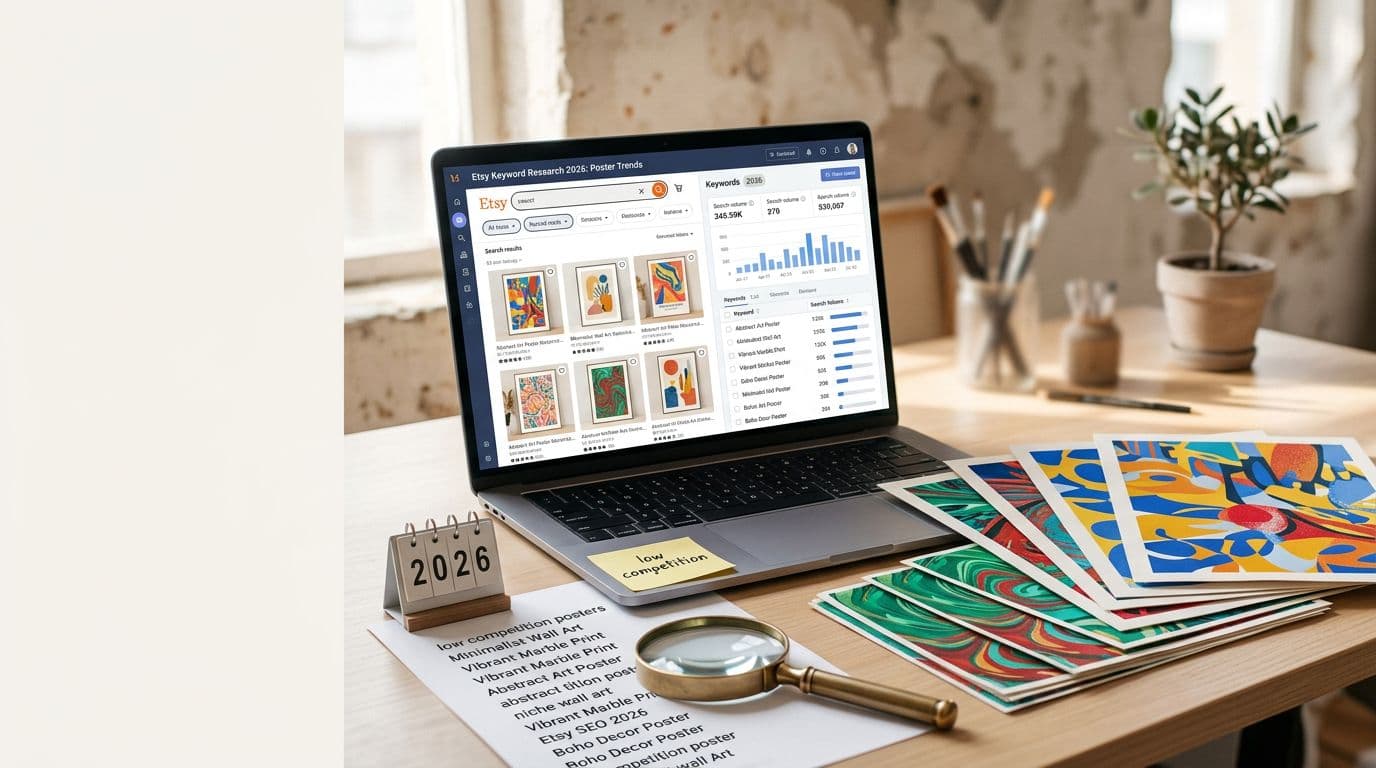
I remember the first time I tried to rank a poster on Etsy. I had one design I loved, a couple of decent mockups, and a vague title that I thought sounded clever. The listing sat there for weeks with single-digit views and zero sales. What changed for me was learning to treat keywords as experiments, not guesses. Once I started picking long-tail, buyer-intent phrases, validating them with real tool data, and committing to a simple test-and-iterate routine, my listings finally found buyers.
If you sell posters or print-on-demand art on Etsy in 2026, this is where the profit sits: in the difference between a crowded head-term and a precise phrase that a real buyer types when they want to buy right now. Etsy keyword research has shifted since a few years back. The platform emphasizes personalization and AI-driven recommendations, which means volume still helps, but the smart play for small shops is to target discoverable, low competition Etsy keywords that buyers use with strong purchase intent. I’m going to share the process I use to find those phrases, the tools I trust, the production math I model, and the automation that made scaling possible for me.
My approach is practical. You’ll get thresholds I use, exact tools I run, and the routine I follow for testing listings. I’ll also show where sellers routinely waste time and how I avoid those mistakes. If you want to find Etsy poster keywords that convert, read this as a playbook, not theory.
Why this matters for Etsy/POD sellers right now
Etsy is still the discovery gatekeeper for poster and wall art buyers in 2026, which matters because visibility equals sales. For posters, small differences in phrasing can mean the difference between being lost in a sea of listings and appearing for a customer who's already decided to buy. I learned that early when a simple change from "botanical poster" to "boho botanical poster 11x14" doubled my views within a week. The reason is straight forward: buyer intent and competition both change when you add details like style, size, and use-case.
Pricing and production are part of the same equation. Etsy fees are predictable: $0.20 listing fee, 6.5% transaction fee on the order total, and payment processing roughly 3% plus a small fixed fee in the U.S. That usually adds up to about a 10% platform cost in practice. For posters I use Printshrimp for fulfillment because their pricing is honest and margins are good; an A1 poster at about £11.49 including shipping gives you room to price for profit, assuming you set prices with those fees in mind. If you skip the math and just chase trends, you can end up with lots of traffic and no profit.
Another reason this matters now is automation. Etsy favors shops with more listings because each listing is another keyword footprint. A few years ago you could manually create the mockups and listings. In 2026, the only practical way to scale to hundreds of test listings is automation for mockups and bulk uploads. This is exactly why I helped build and use tools like Artomate to automate the mockup-to-listing pipeline so you can focus on design and keyword testing. If you want to scale beyond a few dozen variations, automation stops being a luxury and becomes the core of your process.
Finally, this matters because of how search behaves. Etsy rewards engagement signals: click-through rate, favorites, and conversion. Those are driven by the exact search phrases you target and how well your listing matches the buyer's expectation. Spend time to pick the right Etsy poster keywords and you will see better CTR and higher conversion without needing to outspend sellers with massive catalogs.
H3: The business case for keyword focus
I treat keyword research as the first profit lever when I launch a design. Get the phrase wrong and you can throw perfectly good artwork into a well of nothing. Get it right and you wake up to a few sales a week that scale. For one of my travel poster designs, shifting to a long-tail phrase that included the city name, era, and size increased search impressions by 3x and sales by 2x. That’s because the listing matched what the buyer was already looking for, so Etsy showed it more.
Keywords also shape pricing. If a phrase implies a premium use case, like "gallery wall" or "limited edition print," buyers tolerate higher prices. I don’t guess here. I look at top listings, their pricing, and their monthly sales estimate, then decide what price point the market will accept.
H3: Why many sellers miss this
Most sellers treat keywords like tags to check off, not signals to test. They pick nine or ten generic words, jam them into the title, and expect Etsy to do the rest. That rarely works. Etsy’s search favors listings that people click and buy. If your phrase is too broad, your CTR drops and so does organic visibility. The fix is detail and validation: use buyer phrases with intent, check competition counts, and test.
Current market trends: real data points from 2025–2026
I watch a few data signals closely because they directly affect keyword strategy. Etsy’s investment in personalization and loyalty programs in late 2025 means repeat buyers and engaged shoppers are worth more than ever. That pushes sellers to build product lines that encourage multiple purchases. For poster sellers that could mean size variants, matching sets, or print bundles.
Price bands stayed broadly the same: digital downloads commonly sell for $4 to $15, unframed prints sell for $15 to $45, and framed or POD options can be $45 to $85 and up. Those bands matter when you model margins because the way shoppers search and the keywords they use differ by price. A buyer searching a cheap printable often uses different language than someone shopping for a framed gallery print.
Conversion benchmarks are also a heartbeat check. A 2–3% visits-to-sales ratio is average on Etsy. If your listing converts at 3–5%, that’s strong and worth scaling. If your listing sits under 1.5% after a couple of weeks of traffic, you need to fix imagery or copy, or the keyword itself isn’t relevant.
H3: The power of long-tail phrases
Across tools and shops I follow, long-tail phrases are where new sellers find traction. Phrases like "retro travel poster printable 8x10" or "boho botanical poster 11x14" pair buyer intent with specific search demand and lower listing counts. That combination reduces competition and increases the chance of landing on the first page for a focused search.
Those phrases work because they match the mental model of the buyer. When someone searches with size and style included, they are often ready to buy. That means your conversion will be higher and Etsy will feed you more traffic.
H3: Tool signals and seller reports
I cross-check at least two Etsy-focused tools when I validate demand. eRank, EverBee, Marmalead, InsightAgent, and Sale Samurai all show slightly different data, but the patterns hold. If two tools agree that a phrase is rising and the top listings have steady sales, that’s a green light. If one tool shows demand and others don’t, treat it like a weak lead rather than a winner.
There’s also a practical enforcement reality around AI disclosure. Etsy’s policy asks sellers to disclose AI use. In practice, enforcement has been inconsistent. I disclose in listings for buyer trust and to keep records, but I also keep prompts, model names, and version notes for legal safety.
Step-by-step practical strategies: actionable how-to guidance
I run keyword research as a tight operation: collect seeds, validate demand, check top listings, list fast, and iterate. The whole thing should take hours per concept, not days. Below is the workflow I use and what I actually do when a design idea appears.
-
Seed collection. Use Etsy autocomplete by typing core words like "poster," "print," and a few style or use-case modifiers. Spend 10–20 minutes and collect 20–30 seed phrases. These are literal buyer-language fragments and are my starting point.
-
Validate demand. Run seeds through two Etsy keyword tools. I usually use eRank and EverBee together because their signals complement each other. Look for relative search volume, trend direction, and results count. I filter out head terms with astronomical listing counts and focus on mid-to-long phrases.
-
Apply numeric thresholds. My practical cutoffs: aim for result counts under about 20,000 listings for most poster niches; if you want faster traction aim for under 5,000. Also look for steady or rising trend scores over the last 3–6 months. If top listings show sales and price points that match your margins, the keyword is actionable.
-
Check top-listing signals. Open the top 5–10 listings and note monthly sales estimates, price, mockup quality, and review volume. If sellers are selling at a price you can match after Etsy fees and production costs, that indicates demand you can capture.
-
Create a converting listing. Front-load your title with the main keyword and keep natural language in the rest. Use all 13 tags and fill attributes. In the description be explicit about dimensions, file types, printing tips, and shipping. Add an optional short AI-assisted disclosure if you used AI.
-
Test and iterate. Run a modest ad budget, usually $5 to $10 per day, for 7–14 days to gather search-term performance. Pull search-term reports, move winning phrases into your organic title and tags, and tweak imagery to improve CTR. If conversion stays below 1.5% after two weeks, change the mockups, tweak copy, or pause and retest a different keyword.
H3: How I collect seeds effectively
I do seed collection in short sprints. I sit down with a notebook and open Etsy’s search bar. I type "poster" plus a letter and watch the autocomplete suggestions. I write down every sensible phrase. I repeat with style words like "minimal," "vintage," "boho," and use-case words like "nursery," "gallery wall," and sizes such as "8x10" or "11x14." This takes 10 to 20 minutes and gives me the buyer-language I need.
There’s no point collecting hundreds of seeds. Quality beats quantity. I aim for 20 to 30 promising phrases that sound like real buyer queries.
H3: Practical thresholds I actually use
When I screen phrases I want two signals: manageable competition and real buyer intent. Competition under 20,000 is my broad filter. For faster wins I aim under 5,000. Trend direction matters too; I prefer steady or rising terms. If a phrase meets those tests and the top sellers’ pricing fits my margins, I build listings for it.
Those numbers aren’t magic. They are the filters that let me focus time on phrases where an honest small shop has a real shot.
Tools and platforms: what to use (recommended stack)
I keep my stack small but effective. You need reliable image models, a POD partner that doesn’t eat margins, solid Etsy keyword tools, and automation for mockups and uploads. I use a mix of the models and services below and I pick the tool by the task, not by hype.
-
Image generation models: GPT Image 1.5 for precise composition and typography, Nano Banana 2 or Nano Banana Pro for studio-quality control and consistency, and Seedream 5.0 Lite for high-resolution outputs. I pick one model and test a few prompts rather than swapping models constantly.
-
POD: Printshrimp for posters. Their A1 pricing at roughly £11.49 including shipping lets me set prices that comfortably cover fees and leave room for profit. Printful, Printify, and Gelato are okay alternatives if you need different fulfillment locations, but I check their true landed costs before committing.
-
Keyword tools: eRank, EverBee, Marmalead, InsightAgent, and Sale Samurai. I use at least two so I can cross-validate signals.
-
Automation and mockups: I automate mockup creation and bulk listing uploads. For that I use workflow automation and publishing tools that generate lifelike room mockups and push multiple sizes and variants. For shops scaling beyond a handful of listings, automation is non-negotiable and this is exactly why I recommend tools like Artomate for mockup generation and bulk post pipelines. It saves hours and keeps the metadata consistent when you scale to hundreds of listings.
I keep local tools like Photoshop or GIMP for any final retouching and I always make a test print or two to confirm colors and text fidelity.
H3: Why these image models
I picked GPT Image 1.5, Nano Banana 2/Pro, and Seedream 5.0 Lite because they handle poster requirements well. Posters often include typography and tight composition. GPT Image 1.5 is strong when I need predictable edits and text handling with an API. Nano Banana 2 and the Pro variant give me studio-quality consistency, which matters when I build a series of posters with the same style. Seedream is useful when I want 4K outputs and minimal retouching.
Using the right model saves time in post-production and reduces test print waste.
H3: How I use Etsy keyword tools together
Each tool has strengths. eRank is great for historical trend data, EverBee gives practical sales estimates, and InsightAgent helps with listing-level analytics. I run the same seed phrase across two tools and look for agreement. If both tools show reasonable volume and the results count is within my threshold, I move forward. If they disagree, I treat the phrase as uncertain and deprioritize it.
This cross-checking keeps me from chasing false positives from a single data source.
Common mistakes and pitfalls: what sellers get wrong
I’ve seen the same errors in dozens of shops. They’re expensive errors because they waste real time and money. I want to save you the pain.
First, chasing head keywords. New sellers throw everything at terms like "poster" or "vintage poster" and get lost. Those head terms have massive competition and are mostly won by big shops or established brands. I never start with those. Instead I start with long-tail phrases that include size, style, and use-case.
Second, ignoring production math. I model every listing. That means listing fee $0.20, transaction 6.5%, payment processing roughly 3% plus a fixed fee if you’re in the U.S., and the POD cost. If you don’t model this, you may get sales that don’t leave you a profit after costs. For posters I plug in Printshrimp pricing and then set prices that hit my target margin.
Third, relying on a single keyword tool. Etsy is its own ecosystem so I always cross-check two or three tools to avoid false positives. A phrase that looks hot in one tool can be flat in others.
H3: Thumbnail and mockup mistakes
Your first image is everything. I’ve paused a listing for a day and remade the thumbnail, then watched CTR climb. A clean product thumbnail plus a room scene lifestyle image is my standard. Avoid cluttered mockups and heavy text overlays. If a buyer can’t imagine your poster on their wall in the first 2 seconds, they won’t click.
Spend time on that first image. It’s often the cheapest optimization with the biggest impact.
H3: Over-optimizing metadata too quickly
Changing titles and tags every few days is a trap. Etsy needs time to reindex listings and to learn from user behavior. I give changes 2 to 4 weeks before making more edits. If you tinker constantly you can reset any momentum a listing was building.
Make reasoned edits based on data. If a small ad test shows a different search phrase converts better, change the title to include it, then wait.
H3: Skipping provenance and test prints
Even though enforcement around AI disclosure is inconsistent, I document prompts, model names, and versions. I also do test prints. AI models sometimes render text oddly or introduce subtle color shifts. A quick test print saved me from listing files that would have required refunds.
Keeping records and physical proofs reduces legal risk and returns.
Success patterns: real examples and benchmarks from sellers
I don’t like vague storytelling; I like patterns I can repeat. Here are the behaviors that separate shops that grow from ones that tinker forever.
First, volume. Etsy rewards shops that cover more keywords. I’ve watched sellers scale from 50 to 600 listings and their traffic multiplies because each listing is another entry point. That means automation for mockups and bulk publishing is a practical necessity for scaling.
Second, micro-niche focus. The most reliable winners don’t sell "posters" generically. They sell "mid-century botanical print 8x10" or "nostalgic Paris travel poster 11x14." Those micro-niches have fewer listings, clear buyer intent, and price tolerance. If you can produce matching variants (different sizes or colorways) you can own more of that niche.
Third, data-driven iteration. The shops I follow run small ad tests, harvest converting search terms, and then spin up more listings around those terms. They don’t guess. They test, measure, and scale.
H3: Benchmarks I watch
Good conversion is 3–5% on Etsy. If a new listing hits 3% and shows steady purchases at a profitable price, I create size and color variants and run a scaled ad focus. If it’s below 1.5% after initial testing, I improve images and copy.
For competition, I aim for long-tail phrases under 20,000 results. For faster wins I target under 5,000. Those thresholds help me choose opportunities where a small shop can compete.
H3: A repeatable experiment I run
Find a keyword under 20k results with top listings showing regular sales. Create 2–3 variants of the same design across sizes or color palettes. Launch them with polished thumbnails and a short ad test at $5–$10/day for 7–14 days. Pull search-term reports, keep the winners, and pause the losers. Repeat. That experiment is the engine I used to scale a poster line from one sale a week to multiple daily sales.
H3: How automation changes the game
When you can generate consistent mockups and upload dozens of listings in a batch, you stop guessing and start testing. The time you save goes directly into creating more variants and running more experiments. Automation isn’t magic, but it multiplies your ability to find low competition Etsy keywords and scale winners.
SEO and discoverability: current Etsy search and Google strategies
Etsy search blends relevance signals in metadata with listing quality signals like CTR and conversion. That means you have to get both the language right and the listing to perform once shown. I treat SEO and discoverability as two linked problems: matching buyer phrasing and making the listing irresistible when it appears.
Start with metadata. Use all 13 tags and fill attributes. Put the main buyer phrase at the start of your title, and use natural language for the rest. Titles should read like how a buyer would search, not a keyword dump. For poster sellers I use titles that include style, subject, size, and use-case.
Long-tail focus remains the winning strategy for organic search. Phrases like "minimal line art poster nursery 8x10" are specific, low competition Etsy keywords that draw buyers who are ready to buy. That specificity beats a generic head-term every time for a new shop.
H3: Imagery and click-through rate
Thumbnails are the primary factor you can control to move CTR. Use a clear product thumbnail without busy backgrounds and a lifestyle shot as the second image to show context. If your CTR is low, rework the first image. It’s the single most effective on-page change I make for under an hour of work.
I test images by swapping them and watching impressions and clicks. Small changes can move the needle.
H3: Using ads to inform organic SEO
I use small ad campaigns to gather search-term data. Run $5 to $10 per day on new listings for about two weeks, then pull the search-term report. Move converting search phrases into your organic title and tags. That way you let paid tests find the exact buyer language and then lock it into your listing for free traffic.
Paid tests are the fastest way to find high-value Etsy keywords 2026 for your niche.
H3: External channels that pay off
Pinterest and Instagram drive high-value traffic for posters. Pinterest in particular shows up in Google searches for long-tail poster phrases. I pin lifestyle images with keyword-rich descriptions and link back to my Etsy listing. Social traction can help a listing get noticed by Google, which can bring in buyers who start their search off-site.
Keep your off-site descriptions keyword-rich but natural. Think about the buyer phrase you want to own and use that in your pins and posts.
Future outlook: where things are heading based on current trends
If you plan for the next two years, aim to be faster at testing than your competitors. Etsy’s personalization investments mean repeat customers and engaged audiences get preference. That favors shops that create series, bundles, and reasons for repeat purchases.
AI will keep improving. Models that handle typography and consistent character rendering will get even better, which reduces design friction. That makes production faster, but it also increases competition because more sellers will be able to generate decent-looking designs quickly. The answer is still the same: tighter niche keywords and better mockups win.
Policy around AI will keep evolving. I continue to document prompts, models, and versions for legal safety and buyer trust. A short disclosure that a product was AI-assisted builds trust, and keeping records protects you.
H3: Why micro-niches will stay profitable
Head terms will get more crowded as tools make production easier. That pushes price and discoverability pressure to the head. Micro-niches with specific buyer intent will continue to be the best path for new sellers. If you can find a corner of demand where buyers accept your price, you can scale that niche with variants.
This is the same pattern I used to win small pockets of demand and then expand.
H3: Automation and POD differentiation
Automation for mockups and bulk uploads will be the practical barrier to scale. The sellers that automate testing will win simply because they can run more experiments. POD partners who give predictable pricing and fast dispatch help you keep return rates low and margins stable. For posters, Printshrimp’s pricing and shipping model is what I use when I need predictable margins.
Automation and solid fulfillment are the infrastructure of a scalable poster business.
H3: Skills to invest in now
Learn to find buyer language, run small paid tests, and interpret tool data. Learn basic image editing so you can tweak thumbnails. Learn how to batch create variants and upload them with automation. Those skills let you compound wins. If you skip any one of those, you’ll hit a ceiling sooner.
FAQs: common questions sellers ask
I get the same handful of questions all the time, so I answered the practical ones I hear most often and gave exact thresholds I use.
H3: Do I have to disclose AI use on Etsy?
Etsy’s policy asks for disclosure. In practice enforcement in 2026 is inconsistent. I include a short "AI-assisted" note in listings because it builds trust and keeps a record of provenance. I also keep a private log of prompts, model names, and versions in case I need to prove chains of creation later.
This is cheap insurance and it reassures many buyers.
H3: Which AI model should I use for poster typography?
For text-heavy posters I prefer GPT Image 1.5 or Nano Banana 2/Pro because they handle text and composition more reliably than most other models. Seedream 5.0 Lite is great when I need high-resolution outputs with minimal retouching. Test the model with a proof print before you publish.
H3: What competition cutoff should I target?
I use results counts as a quick filter. Aim under 20,000 results for most poster niches. If you want faster traction, aim under 5,000 results. Those numbers aren’t rules, they are a way to focus on phrases where a small shop has a chance.
H3: How should I structure titles and tags?
Use all 13 tags and fill attributes. Front-load your main phrase in the title and write it in natural language. Include size, style, and use-case when possible. Track performance and only make changes after two to four weeks so Etsy has time to reindex the listing.
H3: Which POD partner gives the best margins?
For posters I use Printshrimp because of their pricing transparency and shipping-included model. An A1 poster at about £11.49 including shipping lets you price for healthy margins. Printful, Printify, and Gelato can work depending on your market, but always model landed cost and test prints.
Final Thoughts
If you remember one practical idea from this, make it this: treat keyword research as an experiment you can run fast. Collect buyer-language seeds, validate them with two tools, screen for manageable competition, and test with small ad budgets while you perfect thumbnails. That loop turned slow listings into reliable sellers for me.
Keyword discipline plus good mockups and predictable fulfillment is how small shops win on Etsy in 2026. Automate the tedious pieces, test relentlessly, and keep the math simple. If you want to save time on mockups and bulk uploads, tools like Artomate make the scale part realistic. Get the keywords right and everything downstream works better.

George Jefferson
Founder of Artomate
George has generated over £100k selling AI-generated posters on Etsy and built Artomate to automate the entire print-on-demand workflow. He writes about AI art, Etsy strategy, and scaling a POD business.
Learn more about me →